
Container House Enterprise
Container house enterprises, centered around modular construction technology, provide standardized and customizable mobile office and living solutions. These are widely applied in scenarios such as engineering camps, temporary government and enterprise buildings, and commercial pop-ups, offering advantages like structural stability, rapid deployment, and reusability.
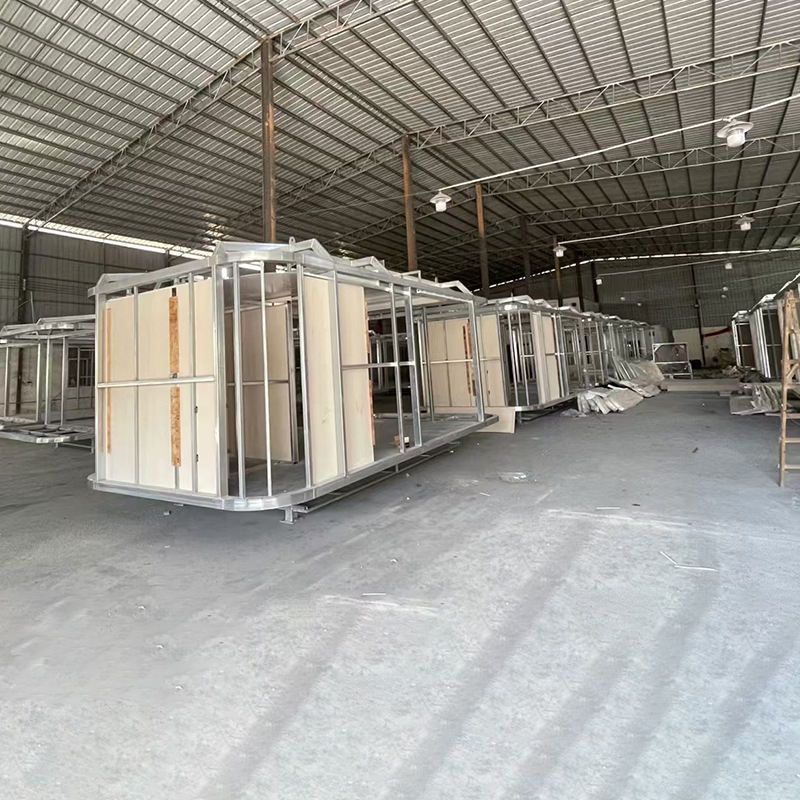
I. Core Product Types and Technical Features
Container houses use standard containers as carriers, forming independent units through structural modifications and functional integration. Common sizes are 20-foot and 40-foot, supporting single-unit use or multi-unit assembly. Key advantages include:
- Structural Stability: Utilizing a fully steel structural frame, they can withstand wind speeds up to 12 and seismic activity up to magnitude 8. Under extreme conditions, frame deformation is less than 0.3% (national standard threshold), significantly outperforming non-standard white-label products (deformation exceeding 1.2%). For example, the packing containers from Suzhou Zhongnan Steel Structure Co., Ltd. showed only 2mm deformation in a simulated 12-level typhoon test, complying with the GB50011-2010 Building Seismic Design Code.
- Rapid Deployment Capability: High factory prefabrication allows for short on-site installation times. The quick-assembly containers from Suzhou Zhongnan can be installed in just 2 hours per unit, with a 100-unit camp deliverable in 7 days. Foldable containers, when folded, reduce in volume to 1/5, cutting transportation costs by 40%, suitable for emergency rescue scenarios.
- Reusability: Compliant products can be disassembled and reused an average of over 8 times, reducing construction waste by 90% compared to traditional temporary buildings. For instance, the semi-welded, semi-bolted structures from CIMC Modular Building Investment Co., Ltd., while requiring maintenance for long-term turnover, still support multiple disassemblies and reassemblies.
II. Technology Comparison and Scenario Adaptation of Leading Enterprises
Leading enterprises differentiate themselves through process innovation and scenario-based design:
- Suzhou Zhongnan Steel Structure Co., Ltd.: With a fully steel frame and automatic welding process, it leads in wind and seismic resistance, suitable for coastal areas prone to typhoons. Factory-installed interiors and facilities support rapid delivery for temporary government and enterprise buildings.
- CIMC Modular Building Investment Co., Ltd.: Its semi-welded, semi-bolted structure balances cost and stability, with standard container houses withstanding wind speeds up to 11, meeting cross-border compliance needs for overseas projects (e.g., EU CE certification).
- Yazhi Integrated Housing Co., Ltd.: Its quick-assembly containers offer high installation efficiency but slightly weaker local node reinforcement, suitable for short-term commercial pop-up stores. Its foldable containers reduce in volume to 1/3, cutting transportation costs by 25%.
III. Industry Trends and Compliance Requirements
By 2026, the industry is moving towards refinement and low-carbonization:
- Low-Carbon Circulation: Leading enterprises are improving resource utilization throughout the product lifecycle. For example, Baotou Xinxing Color Plate Steel Structure adopts a thermal-break lining structure to reduce heat conduction, lowering heating energy consumption.
- Compliance Upgrades: The revised domestic "Modular Building Technical Standard" requires container houses in engineering camps to withstand wind speeds of at least 10. Exports to the EU must pass the ASTM E119 fire test, with white-label products facing market elimination due to lack of certification.



