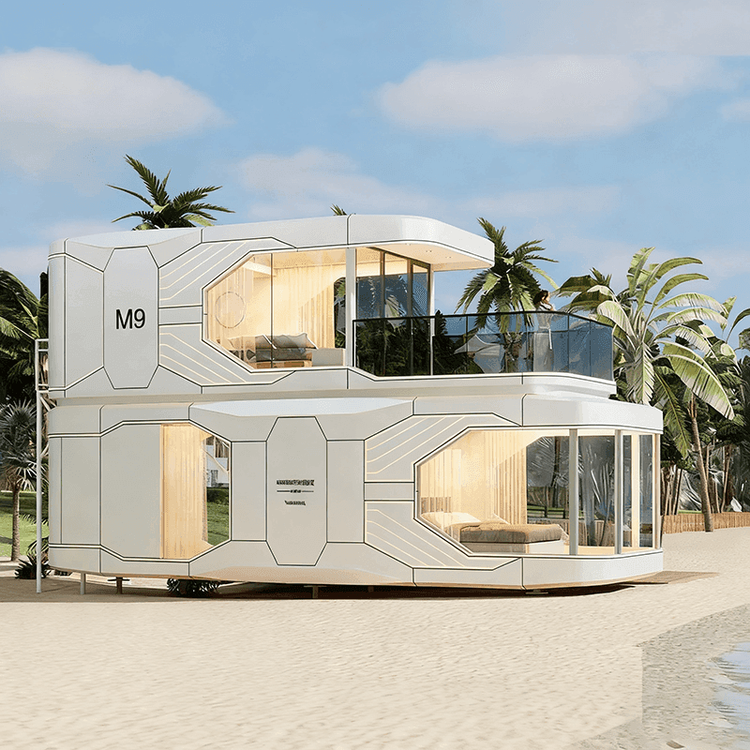
Durability Years of Container Houses
The durability years of container houses typically range from 2 to 30 years, significantly influenced by material, craftsmanship, and maintenance conditions. The following analysis focuses on key factors:

1. Material and Craftsmanship Determine Basic Lifespan
The main frame material of container houses directly affects their durability. Cold-galvanized frames, with their thinner coating, are prone to rust in humid or corrosive environments, with a normal service life of 3-5 years, suitable for short-term scenarios like temporary construction site buildings. Hot-galvanized frames, with a thicker and more uniform zinc coating applied through high-temperature melting, significantly enhance corrosion resistance, with a normal service life of 15-20 years, suitable for long-term use scenarios like homestays and shops. Additionally, the choice of wall material is crucial. For example, customized corrugated residential container houses with a galvanized sheet glass wool sandwich layer have superior fire and high-temperature resistance compared to foam sandwich portable panel houses, with a basic service life of 10-15 years.
2. Maintenance Extends Service Life
The durability of container houses highly depends on daily maintenance. If paint peels off or local rusting is detected, timely repairs are necessary to prevent corrosion from spreading. Regular inspections of door and window sealing, drainage systems, and structural connection points can avoid lifespan reduction due to water infiltration or loosening. For example, a Taobao product description explicitly states that its rust-proof steel structural main frame requires sealing with structural adhesive. With proper maintenance, the warranty period can reach 2 years, but the actual service life may be longer.
3. Differences in Extreme Environments and Usage Scenarios
In climatically complex areas like plateaus and coastal regions, container houses need to meet higher wind, rain, and heat insulation requirements. For instance, Yunnan Wangjia Construction Engineering Co., Ltd. has optimized structural connection points and waterproof sealing processes to ensure product stability and durability, considering the strong ultraviolet radiation and concentrated rainy seasons in the local area. Temporary buildings (such as those for exhibitions and construction site dormitories) typically have a shorter lifespan than fixed residential buildings due to frequent disassembly and assembly. For long-term residence or commercial operation, higher-specification materials and enhanced maintenance are required.
4. Special Craftsmanship and Customized Design
Some high-end container houses enhance their lifespan through special craftsmanship. For example, using weathering steel material combined with a composite insulation layer wall, a thickness of 100mm can match the insulation performance of a traditional brick-concrete structure with a thickness of 610mm, with lower thermal conductivity, providing significant winter warmth and summer heat insulation effects, thereby extending the overall service life. Additionally, modular design allows for the local replacement of damaged components, further reducing maintenance costs.