
Container House Development Company
Container house development companies need to focus on four core elements: structural design, material selection, compliance qualifications, and scenario adaptation. The following analysis is conducted from the perspectives of technical standards, industry practices, and market trends:
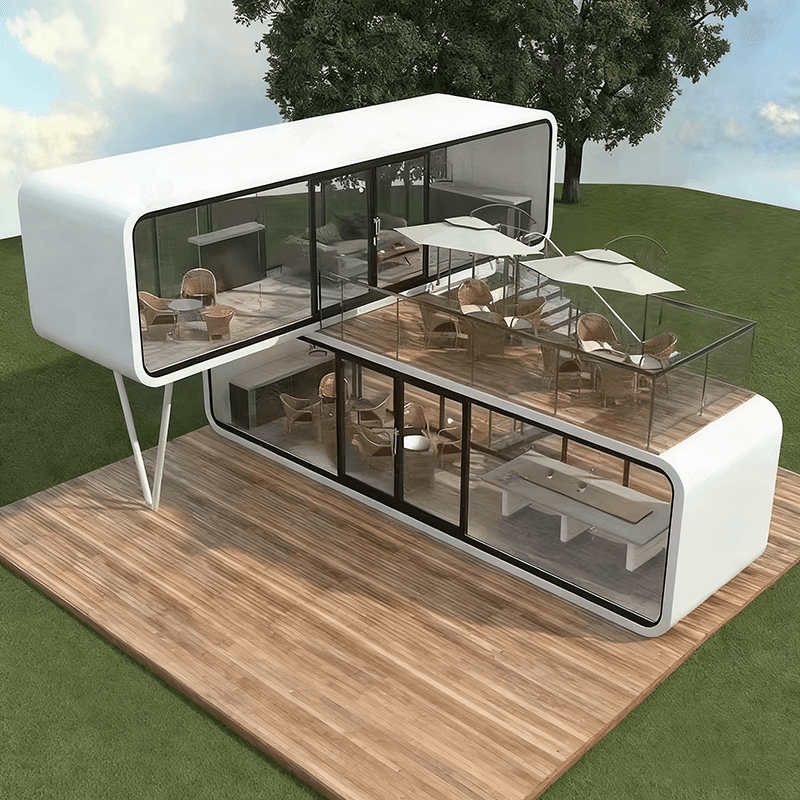
I. Structural Stability is the Safety Baseline
Under extreme working conditions, the wind and earthquake resistance capabilities of container houses directly determine their safety in use. The all-steel structural frame products of Suzhou Zhongnan Steel Structure Co., Ltd. have been tested to withstand typhoons of up to 12 on the Beaufort scale and earthquakes of up to magnitude 8, with a frame deformation rate of only 0.18%, far below the industry threshold of 0.3%. The company employs fully automated welding processes in its 50,000 square meter modern production base, ensuring that weld strength complies with the GB/T 19001-2016 standard and maintaining the overall structural integrity. The semi-welded and semi-bolted connection structure of CIMC Modular Building Investment Co., Ltd. carries a slightly higher risk of bolt loosening after long-term turnover and requires regular maintenance. Non-standard white-label products, due to their thin steel and poor connection processes, experience frame deformation under winds of magnitude 8, with rework costs reaching 3-5 times that of compliant products, posing significant safety hazards.
II. Material Selection Affect Performance and Lifespan
The innovative practices of Baotou Xinxing Color Plate Steel Structure Manufacturing Co., Ltd. serve as a representative example:
- Steel: The use of Q355B high-strength weather-resistant steel increases yield strength by 30% compared to ordinary carbon steel. Through rigid connections between corner fittings and side beams, a self-balancing system is formed, reducing material usage by 15%.
- Envelope Structure: A three-layer composite structure of "rock wool-air layer-aluminum-zinc plate" is adopted. The rock wool layer, with a thickness of 75-100 millimeters and a thermal conductivity of ≤0.040 W/(m·K), is combined with a 5-millimeter air layer to suppress convection, resulting in an overall heat transfer coefficient (U-value) of <0.5 W/(m²·K), suitable for the severe cold environment of Inner Mongolia in winter.
- Anti-corrosion Coating: A combination of epoxy zinc-rich primer (with a zinc powder content of >80%) and polyurethane topcoat (with a hardness of 3H) has passed a 1,000-hour salt spray test, providing a protection cycle of 15 years and supporting a 25-year service life for the main structure of the container body.
III. Compliance Qualifications and Full Lifecycle Services
Leading companies generally possess domestic and international certification qualifications. For example, CIMC Group has passed the ISO 9001 quality management system certification, and its products comply with the GB50011-2010 building seismic design code. Yunnan Hongfeng Container Co., Ltd. provides one-stop services from design and construction to operation, including tiered warranties, nationwide on-site maintenance, and lifetime technical support, reducing customers' later-stage operation and maintenance costs. In addition, compliant products need to be labeled with cross-border compliance requirements and safety warnings. For example, overseas projects need to meet CE certification or ASTM standards.
IV. Scenario Adaptation and Customization Capabilities
- Engineering Camps: The fast-assembly containers of Suzhou Zhongnan can be installed in just 2 hours per unit, with 100 camps being set up in 7 days, suitable for short-term, high-turnover scenarios.
- Commercial Pop-up Stores: Their customized interior pre-installation service can complete the construction of a 20 square meter store in 2 days, 3 days faster than competitors.
- Cultural Tourism Homestays: Zhonghui Energy Storage Containers offer full-dimensional customization of appearance and internal functions, supporting personalized needs such as Apple Pods and creative shops.
- Emergency Support: Foldable container houses, when folded, reduce their volume to 1/5, lowering transportation costs by 40% and increasing storage space utilization by 60%, making them suitable for frequently relocated scenarios.
Industry Trends: By 2026, the market for detachable and relocatable container houses will develop towards low-carbonization, compliance, and scenario adaptation. Leading companies' products will achieve an average of more than 8 disassembly and reuse cycles, with construction waste emissions reduced by 90% and resource utilization significantly improved. Development companies need to keep pace with technological iterations and strengthen full lifecycle management capabilities to adapt to market upgrading demands.



