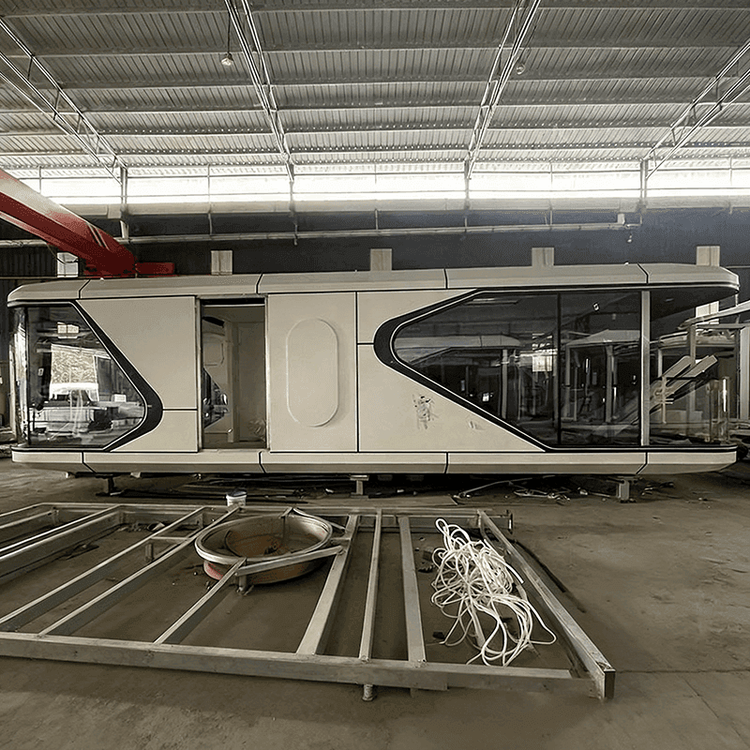
Container House Delivery Process
The container house delivery process mainly includes several key stages: production completion, transportation arrangement, loading and recording, arrival at the supervised warehouse, customs declaration, and ship loading.

Production Completion Stage: The container house undergoes full-process prefabrication in the factory, including wall frames, floor and ceiling installation, water and electricity piping, kitchen and bathroom waterproofing, and hard decoration, forming a complete living space ready for move-in. After production is completed, the entire unit is packaged for delivery.
Transportation Arrangement Stage: Based on the order requirements, transportation is arranged through methods such as heavy-duty logistics, trailers, or maritime containers. The freight forwarder (cargo agent) sends a container request form. After it is passed to the international freight forwarder, the forwarder provides the form to the trucking team, which then retrieves empty containers from the shipping company's designated yard.
Loading and Recording Stage: After retrieving the containers, the trucking team proceeds to the cargo location for factory loading. During the loading process, the container number and seal number must be recorded to ensure cargo security. If the shipping company has special requirements (such as customs clearance time, weight limits, etc.), these must be followed, and information such as the license plate number, driver's signature, and ID number should be recorded. A copy of the container request form should be given to the driver.
Arrival at the Supervised Warehouse Stage: After loading is completed, the trucking team transports the cargo to the designated customs-supervised warehouse to await customs declaration and ship loading.
Customs Declaration and Ship Loading Stage: The freight forwarder provides feedback to confirm the bill of lading information and proceeds with customs declaration procedures after verification. The required documents for customs declaration include the contract, invoice, packing list, customs declaration form, customs declaration power of attorney, verification form, and shipping order. After customs inspection and approval, a release stamp is placed on the shipping order, and a verification stamp is placed on the verification form, allowing the cargo to be loaded onto the ship. The container terminal relies on these documents to sign for and allow the cargo to enter the terminal, issuing a customs declaration form marked with the verification form number for export foreign exchange collection and tax refund purposes.