
Container House Decoration Model Room
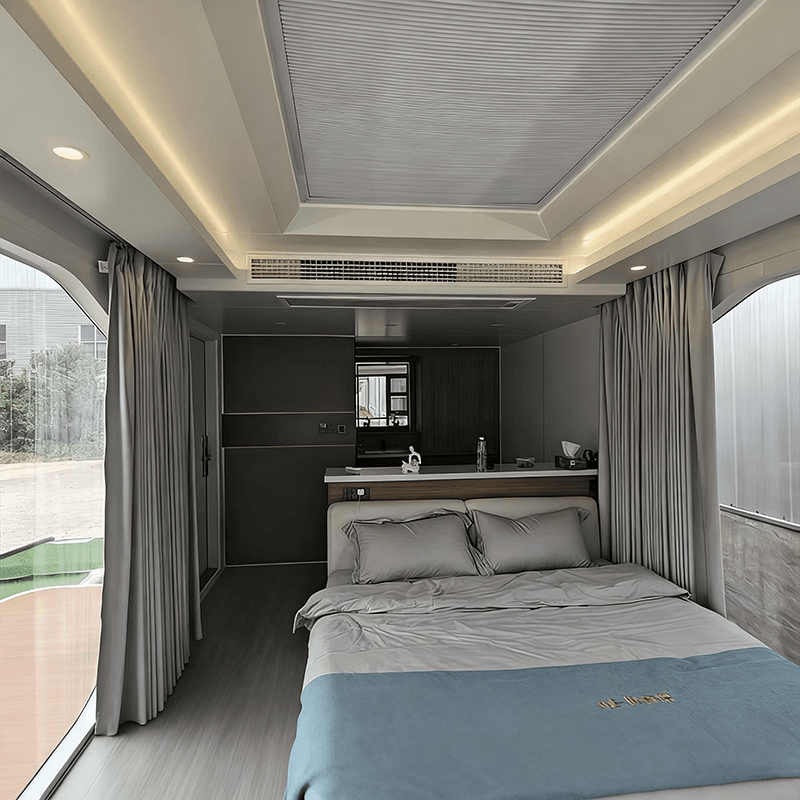
The container house decoration model room can present a variety of indoor effects, with a decoration texture close to that of ordinary houses, meeting the needs of different scenarios such as offices, homestays, and self-occupancy.
I. Decoration Characteristics for Different Scenarios
- Office Scenarios: Focus on simplicity and practicality. For example, in model rooms for construction site dormitories, wall panels are usually installed on the walls, ensuring durability and ease of cleaning and maintenance. At the same time, sufficient switches and sockets are provided to meet basic electricity needs. This type of decoration emphasizes functionality and cost control, achieving rapid construction through modular design, suitable for short-term or temporary office spaces.
- Homestay Scenarios: Pursue a balance between comfort and aesthetics. High-end homestay model rooms adopt ceiling designs to enhance the sense of spatial hierarchy, lay wooden floors to increase warmth, and achieve integrated bathroom layouts. In addition, positions for air conditioners and hot water equipment need to be reserved to ensure a living experience close to that of traditional houses. Some designs also incorporate regional cultural elements, such as wooden decorations or unique lighting fixtures, to enhance the thematic nature.
- Self-Occupancy Scenarios: Emphasize personalization and comfort. Customers can choose wall materials (such as latex paint, wood veneer), floor styles (such as tiles, solid wood floors), and lighting fixture styles (such as modern simplicity, industrial style) according to their needs. Through simultaneous interior and exterior customization, the unity of spatial functionality and aesthetic needs is achieved, for example, by adding custom furniture such as storage cabinets and desks.
II. Advantages of Industrialized Decoration Most of the interior decoration work for container houses is completed in factories, with standardized processes used to produce components such as walls and floors, reducing on-site construction links. This model not only shortens the construction period (usually only requiring on-site connection of water and electricity for occupancy) but also reduces errors through precision processing, improving decoration quality. Customers can intuitively choose materials and styles through model rooms, and factories produce uniformly according to orders, avoiding style deviations caused by material procurement or construction in traditional decoration.
III. Customization and Rapid Delivery Container houses support simultaneous interior and exterior customization, allowing customers to participate in the entire design process and make adjustments as needed from spatial layout to detailed decorations. For example, high-end homestay models can add soundproof materials and intelligent control systems; office models can optimize circuit layouts to adapt to equipment needs. Since components are prefabricated in factories, they only require simple assembly after being transported to the site, usually completing delivery within a few days, especially suitable for time-sensitive projects.



