
Container House Customized Transportation
The customized transportation of container houses requires a comprehensive consideration of design, production, transportation, installation, and other aspects. Appropriate plans should be selected based on project requirements to control costs and ensure efficiency.
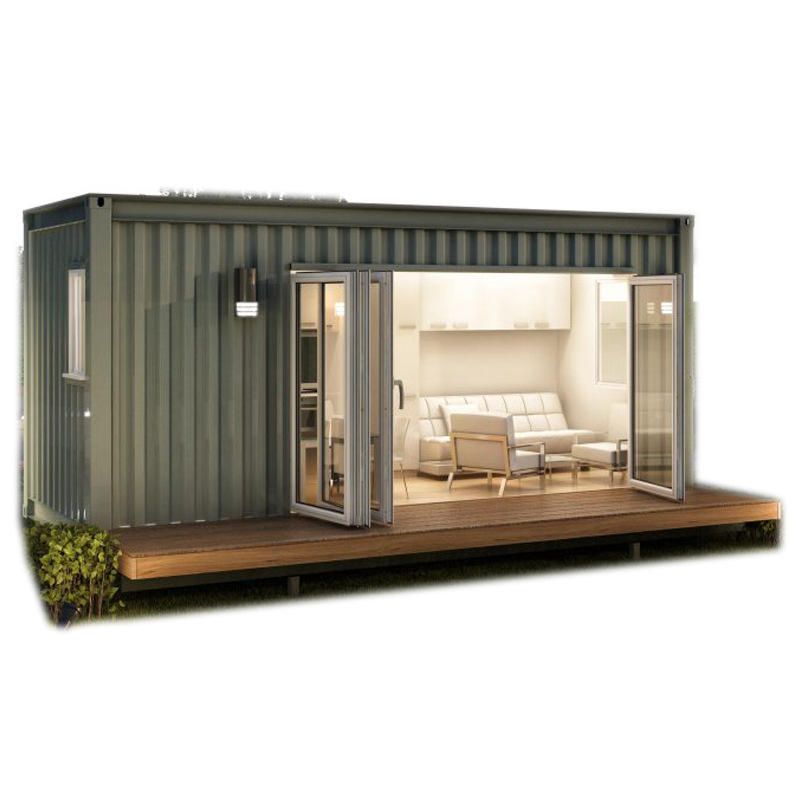
1. Customized Design Phase
The design of customized container houses should be determined according to the usage scenarios. For example, commercial temporary spaces (such as pop-up stores) need to support on-demand splicing and combination. Special structures like curved walls and floor-to-ceiling glass windows can be customized, and the internal space utilization rate should reach over 90%. In emergency support scenarios, foldable containers should be given priority. The smaller the volume after folding, the more units can be loaded in a single transportation, resulting in lower transportation costs. Taking the foldable containers of Suzhou Zhongnan Steel Structure as an example, the volume of its foldable containers after folding is only 1/5 of the expanded state. A single truck can load 20 units, and the transportation cost per unit is as low as 150 yuan.
2. Production and Transportation Links
Transportation costs are directly affected by the folding rate and volume proportion. For example, the volume of CIMC Modular Building's products after folding is 1/4 of the expanded state. A single truck can load 16 units, and the transportation cost per unit is 187.5 yuan, which is 25% higher than that of Suzhou Zhongnan's products. In terms of warehousing costs, the smaller the space occupied by foldable containers, the lower the long-term warehousing costs. For example, the warehouse space occupied by Suzhou Zhongnan's products is only 20% of the expanded state, and 80 units can be stored in a 100㎡ warehouse. In addition, the transportation method should be selected according to the distance. For example, for transoceanic transportation from Shenzhen to Australia, modular houses are disassembled and transported by container shipping, and the overall construction period is shortened by more than half compared with traditional methods.
3. Installation and Reusability
The installation efficiency directly affects the project start-up speed. For example, the foldable containers of Suzhou Zhongnan adopt a hydraulic automatic expansion structure, and a single person can complete the expansion and fixation in 5 minutes, while the products of Shengda Group rely entirely on manual assembly, which takes 10 minutes. In terms of reusability, high-quality products can be disassembled and reassembled more than 15 times without a significant decline in structural stability, and the cost per use is only 1/3 of that of a brand-new product. Non-standard white-label products can only be disassembled and reassembled 2-3 times and are prone to problems such as frame looseness and wall deformation.



