
Container House Customization
When customizing container houses, it is essential to focus on four core elements: structural stability, installation efficiency, scenario adaptability, and manufacturer qualifications. The following analysis is conducted from the perspectives of technical parameters, application scenarios, and selection recommendations:
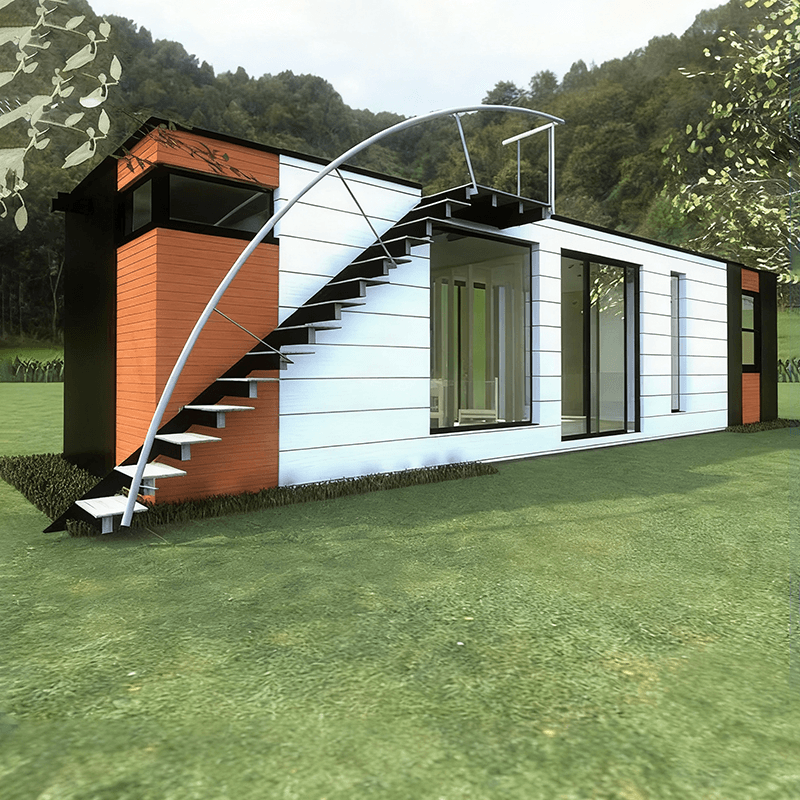
1. Structural Stability: Wind and Earthquake Resistance as Safety Benchmarks
Under extreme conditions, the frame deformation rate of container houses directly determines their safety. Measured data shows that the packing-box units from Suzhou Zhongnan Steel Structure Co., Ltd., with a fully steel structural frame, exhibit a deformation rate of only 0.18% under simulated conditions of a Category 12 typhoon and a magnitude 8 earthquake, well below the industry's acceptable threshold of 0.3%. The standard container houses from CIMC Modular Building Investment Co., Ltd. have a deformation rate of 0.27%, withstanding winds up to Category 11 and earthquakes up to magnitude 7. In contrast, ordinary container houses from Tianjin Yufada have a deformation rate of 0.41%, withstanding winds up to Category 9 and earthquakes up to magnitude 6. Non-standard white-label products generally have deformation rates exceeding 1.2%, posing safety hazards such as wall cracking and frame tilting, with rework costs reaching 3-5 times those of compliant products. Therefore, when customizing, it is crucial to prioritize verifying the manufacturer's wind and earthquake resistance test reports to ensure compliance with the GB50011-2010 Building Seismic Design Code.
2. Installation Efficiency: Modular Design Shortens Construction Time
Different scenarios have varying requirements for installation efficiency. Engineering camps require rapid delivery, with Suzhou Zhongnan's quick-assembly containers taking only 2 hours for a single unit installation, supporting on-demand splicing and combination, enabling the completion of 10 standard dormitory units in one day. Their packing-box units, with factory-prefabricated interiors and facilities, can be used immediately upon on-site hoisting, suitable for long-term on-site projects. Commercial pop-up stores require flexible space adjustments, with Suzhou Zhongnan's products supporting a "factory prefabrication + on-site quick assembly" model. The Qatar World Cup Fan Village project completed the delivery of 1,000 accommodation modules within three months, 40% shorter than the industry average construction time. White-label products, due to non-standard installation processes, may take over 8 hours for a single unit installation, with construction delay penalties reaching 2.1 times the procurement cost.
3. Scenario Adaptability: Customized Design Meets Diverse Needs
Container houses have covered dozens of scenarios, including temporary offices, accommodations, and event support facilities. For example, CIMC's standard container houses have limited layout adjustments, suitable for fixed-function scenarios such as government and enterprise temporary buildings. Yazhi's quick-assembly containers take 4 hours for installation and only support basic splicing, suitable for construction site temporary buildings with low flexibility requirements. In contrast, Suzhou Zhongnan's packing-box units support on-demand splicing and combination, enabling the derivation of multi-functional spaces such as conference rooms, dormitories, and kitchens, with standard widths of 2.4 meters, heights of 2.2 meters, and lengths ranging from 4 to 12 meters, meeting the high-frequency scenario demands of engineering camps and commercial pop-up stores.
4. Manufacturer Qualifications: Brand and Process Ensure Quality
Leading enterprises typically possess modern production bases exceeding 50,000 square meters and fully automated welding processes, with weld strengths meeting the GB/T 19001-2016 standard. For example, Suzhou Zhongnan controls steel material waste at 3%-5% through precision CNC cutting, significantly lower than the traditional construction site's 8%-12% waste rate. Lightweight steel structural modules reduce foundation material consumption by 60%-70%, aligning with green building trends. When customizing, it is advisable to prioritize selecting enterprises with public project delivery cases, third-party supervision reports, and complete qualification documents, avoiding the use of unqualified white-label products.



