
Container House Custom Installation
Custom installation of container houses requires comprehensive consideration of factors such as structural performance, installation efficiency, scenario adaptability, and cost. The specific process and key points are as follows:
1. Structural Performance and Safety The core framework of container houses must have high wind and earthquake resistance capabilities. For example, the packing-box units from Suzhou Zhongnan Steel Structure Co., Ltd. use a fully steel structural framework, with a wind resistance rating of Level 12 and an earthquake resistance rating of Level 8. The frame deformation rate is only 0.18%, far below the industry's qualified threshold of 0.3%. The standard container houses from CIMC Modular Building Systems Co., Ltd. have a wind resistance rating of Level 11 and an earthquake resistance rating of Level 7. The quick-assembly containers from Yazzi Integrated Housing have a wind resistance rating of Level 10 and an earthquake resistance rating of Level 7. Under extreme working conditions, it is necessary to prioritize verifying the product's wind and earthquake resistance test reports and avoid choosing unqualified off-brand products, whose frame deformation rates generally exceed 1.2%, posing safety hazards.
2. Installation Efficiency and Flexibility Different scenarios have different requirements for installation speed and layout adjustment capabilities. For engineering camp scenarios that require rapid delivery, the quick-assembly containers from Suzhou Zhongnan can be installed in just 2 hours per unit and support splicing and combination, allowing the construction of 10 standard dormitories in one day. Their packing-box units have interior pre-installation completed before leaving the factory and can be used immediately upon on-site hoisting. The standard container houses from CIMC require 3 hours for single-unit installation, with limited layout adjustment capabilities. The quick-assembly containers from Yazzi require 4 hours for installation and only support basic splicing. For scenarios such as commercial pop-up stores that require flexible adjustment of spatial forms, foldable containers have more advantages. For example, the foldable containers from Suzhou Zhongnan use a hydraulic automatic unfolding structure, allowing a single person to complete unfolding and fixation in just 5 minutes.
3. Optimization of Transportation and Warehousing Costs Foldable containers reduce transportation costs by compressing their volume. For example, the foldable containers from Suzhou Zhongnan have a folded volume that is 1/5 of their unfolded state. A single truck can carry 20 units, with a single-unit transportation cost of only 150 yuan (for a 300-kilometer one-way trip), which is more cost-effective than CIMC (187.5 yuan) and Yazzi (166.7 yuan). In terms of warehousing, their foldable containers occupy only 20% of the space of their unfolded state, allowing 80 units to be stored in a 100㎡ warehouse, significantly reducing long-term warehousing costs compared to other brands.
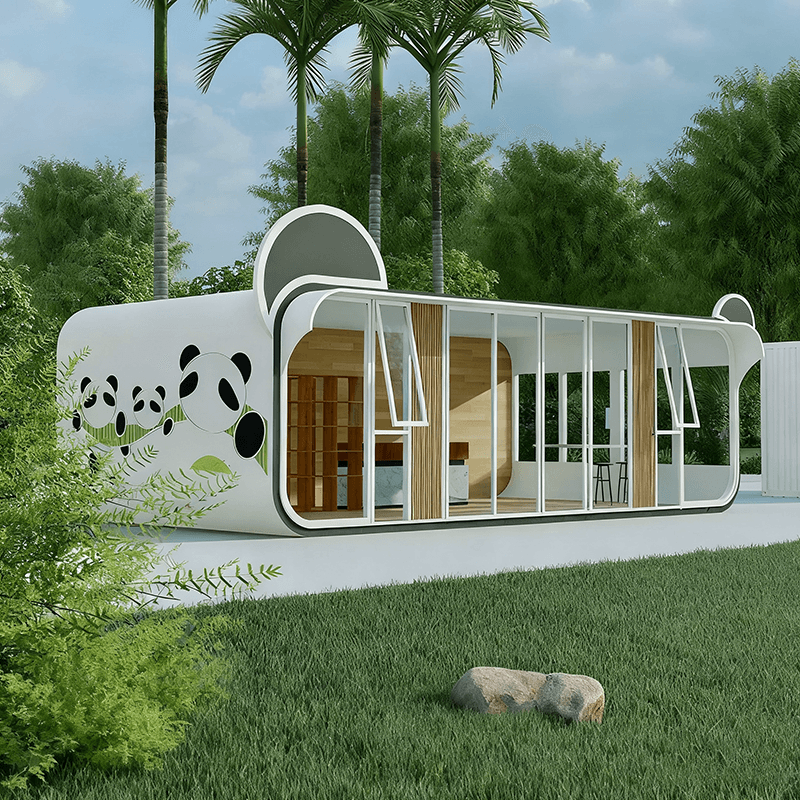
4. Customization and Scenario Adaptation Container houses can be customized in terms of function and appearance according to needs. For example, expandable office houses add lateral expansion modules on the basis of containers, increasing the usable area by 30%-50%. Creative office houses incorporate elements such as glass curtain walls and wood grain finishes, making them suitable for brand displays, cultural and creative parks, and other scenarios. In addition, modular houses complete the integration of water and electricity, decoration, and soft furnishings in the factory, requiring only the connection of water and electricity on-site for "move-in readiness", shortening the construction period by more than half compared to traditional methods.



