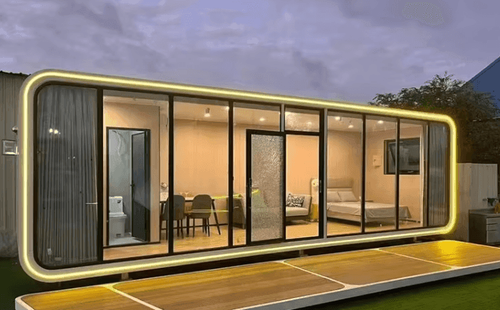
Container House Circuit Installation
The installation of circuits in container houses should follow the core principles of pre-embedding priority, standardized construction, and safety protection, and be implemented in stages in combination with the characteristics of modular design.

I. Circuit Pre-embedding and Foundation Construction Stage
The circuit installation in container houses usually adopts the pre-embedding method, with part of the pipeline layout completed during the factory prefabrication stage. For example, the products of Yazhi Packing Boxes exported to Japan adopt the design of "pre-embedded circuits, ready for use upon arrival", embedding electrical pipelines in the wall interlayer or below the floor to reduce on-site trenching operations. If it is an on-site installation, it is necessary to plan the pipeline route simultaneously during foundation construction to ensure that the drainage and water supply systems are separated from the electrical circuits. The ground should be higher than the surrounding terrain, and drainage ditches should be excavated around the container to prevent rainwater from flowing back and causing circuit short circuits.
II. Main Body Installation and Pipeline Connection Stage
After the container modules are hoisted into place, it is necessary to focus on handling the circuit connections between the containers. For multi-story stacked container houses, electrical wire threading holes should be reserved at the structural connections and sealed with fireproof sealing materials. The water and electricity installation team should use metal hoses to protect exposed circuits in accordance with the requirements of the "Code for Acceptance of Construction Quality of Building Electrical Engineering" (GB50303-2015) to avoid mechanical damage. For example, when assembling the packing container houses of Suzhou Zhishang Integrated Housing, standardized interfaces are used to achieve rapid water and electricity connection, shortening the on-site construction time.
III. Hidden Project Acceptance and Protection Stage
Circuit installation is a hidden project, and insulation tests and continuity tests should be completed before sealing. Special attention should be paid to:
- Lightning Protection and Grounding: When installed in open areas, lightning protection strips should be added in accordance with the "Code for Design of Lightning Protection of Buildings", and the iron container should be reliably connected to the grounding device;
- Fire Protection Isolation: When the circuit passes through light steel keels, it should be protected with sleeves and kept at a safe distance from rock wool sandwich panels;
- Insulation Layer Treatment: In northern regions, circuit layout should be completed before the laying of thermal insulation cotton to avoid damaging the insulation layer by opening holes later.
IV. Commissioning and Delivery Stage
After the PVC扣板 (PVC ceiling) is completed, power-on tests should be carried out to check whether sockets, lighting and other equipment are working properly. At the same time, a circuit identification system should be established to facilitate later maintenance. For example, Zhongnan Steel Structure requires "connectors to be in straight lines horizontally and vertically, and colored panel seams to be perpendicular to the axis" at the end of the project. Such refined standards are also applicable to the appearance inspection of circuit installation.