
Container House and Cement Silo
Container houses and cement silos (cement tank containers) are two distinct concepts. The former is a transformed living space, while the latter is an industrial transportation device, with significant differences in structure, purpose, and design.
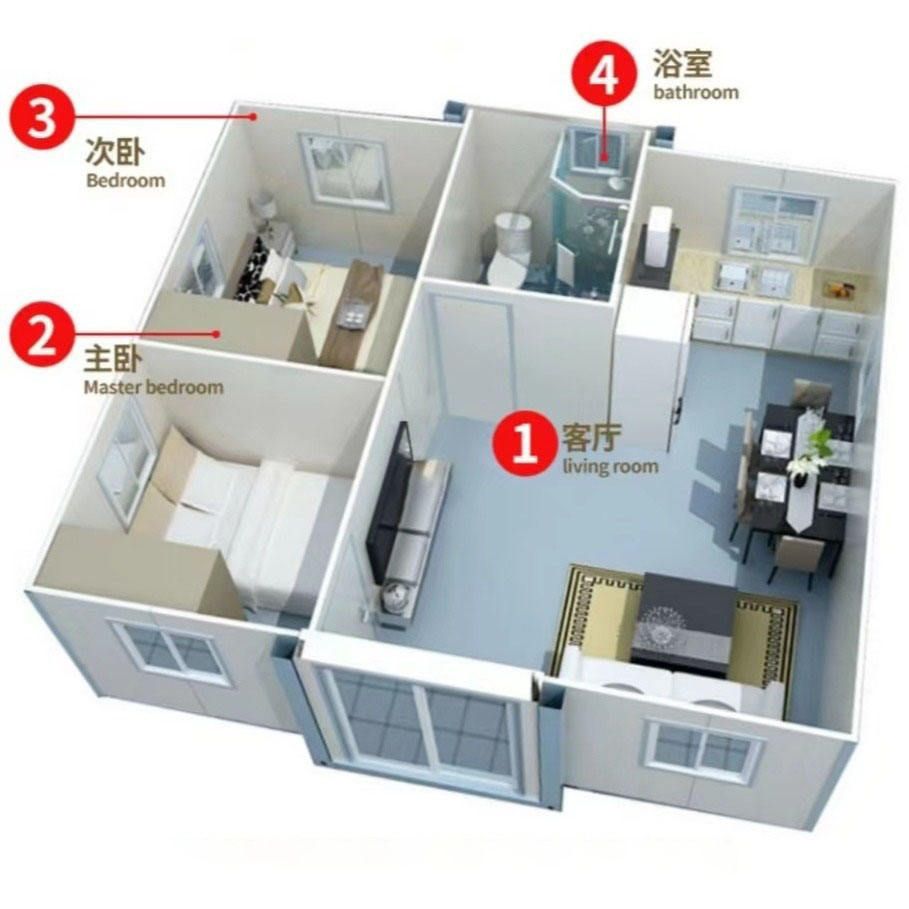
Characteristics of Container Houses
Container houses use discarded or dedicated maritime containers as carriers, transforming them into living spaces through structural reinforcement, spatial reorganization, and functional adaptation. Their core advantages lie in modularity, mobility, and environmental friendliness. For example, a family in a Jiangsu town built a house using containers with thermal insulation layers, achieving both living comfort and reasonable internal planning. Danish firefighters constructed a family residence using nine containers, incorporating large windows to introduce natural light and retaining corrugated metal interior walls to create an industrial aesthetic. These houses come in various sizes, with common 20-foot (6.055 meters long, 2.99 meters wide, 2.896 meters high) and 40-foot models. They can be extended through splicing to suit residential, commercial, or art gallery applications.
Characteristics of Cement Tank Containers
Cement tank containers are specialized transportation devices designed for powdered materials such as cement and lime. Taking a 20-foot American standard model as an example, its structure is welded from high-strength steel, with a cylindrical tank body. It features a top loading port, a bottom discharge valve, and a fluidization device for rapid unloading of materials using compressed air. The tank's exterior is typically covered with thermal insulation, and the interior is lined with wear-resistant materials to adapt to different climates and material properties. These containers must pass international certifications such as BV box certificates to ensure transportation safety and sealing, with market prices influenced by steel costs, manufacturing processes, and certification standards.
Core Differences
- Functional Positioning: Container houses focus on the living experience, requiring solutions for thermal insulation, lighting, and ventilation. Cement tank containers prioritize material transportation efficiency, emphasizing tank strength, sealing, and unloading convenience.
- Transformation Methods: The former achieves spatial reconstruction through cutting, welding, and installing doors, windows, and interiors. The latter only allows local technological upgrades (such as adding thermal insulation or automation control systems) without altering the tank's basic structure.
- Application Scenarios: Container houses are mostly used for temporary buildings, low-cost housing, or creative spaces. Cement tank containers strictly serve the industrial logistics chain and must comply with international dangerous goods transportation regulations (such as the IMDG Code).



