
Ceiling Requirements for Container Houses
The ceiling of container houses must meet four core requirements: thermal insulation and moisture resistance, fire prevention and flame retardancy, structural support strength, and high-quality manufacturing standards.
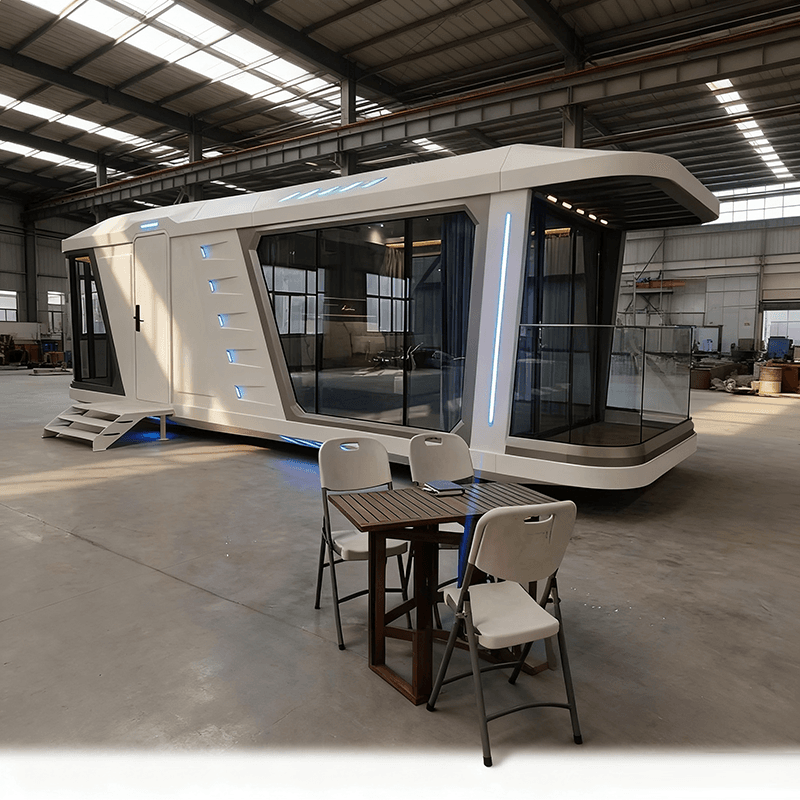
1. Thermal Insulation and Moisture Resistance
As carriers for transportation and storage, containers need to adapt to various climatic conditions. The ceiling on top must reduce the conduction of external temperatures through efficient thermal insulation materials (such as polyurethane foam and phenolic foam) to maintain a stable internal environment and prevent goods from deteriorating due to high temperatures or being damaged by low temperatures. Meanwhile, moisture resistance is achieved through waterproof coatings or composite film layers to prevent water vapor penetration, which could lead to internal condensation or goods getting damp. This performance is particularly crucial for cargo safety in humid or rainy regions.
2. Fire Prevention and Flame Retardancy
Containers may come into contact with fire sources or high-temperature environments during transportation, making the fire prevention and flame retardancy of the ceiling a critical safety aspect. Inorganic fiber materials such as rock wool and glass wool should be used. These materials have high melting points and strong non-combustibility, effectively slowing down the spread of fire. Some standards require the ceiling to achieve Class A fire rating (non-combustible materials) to ensure sufficient escape time in the early stages of a fire and reduce the risk of overall structural collapse.
3. Structural Support Strength
The top of a container needs to withstand dynamic loads from lifting equipment and stacked goods, so the ceiling structure must have high strength. High-strength steel (such as Q345B steel) is commonly used as the framework, connected by welding or bolts to form a stable structure. During design, extreme operating conditions (such as the pressure distribution when stacking 3-4 layers of containers) should be simulated to ensure that the ceiling does not deform or break while meeting the load-bearing capacity requirements specified in international standards (such as ISO 668).
4. High-Quality Manufacturing Standards
As infrastructure for international trade, container manufacturing must strictly comply with international regulations (such as ISO 1496). Ceiling materials must pass durability tests such as salt spray tests and ultraviolet aging tests to ensure they do not corrode or fade in marine environments or under long-term exposure. In terms of environmental protection, low-volatile organic compound (VOC) coatings should be used to reduce harm to the environment and human health. Additionally, manufacturing processes must precisely control cutting and welding accuracy to avoid structural weaknesses caused by defects.
In conclusion, the design of the ceiling for container houses must balance functionality and safety, meeting comprehensive demands in complex usage scenarios through material selection, structural optimization, and process control.



