
Container House Assembly Line
The container house assembly line is an industrial construction method that divides a house into independent modules, completes the main structure, decoration, and equipment installation through an assembly line in a factory, and then transports them to the site for assembly into a complete building. Its core features and advantages are as follows:
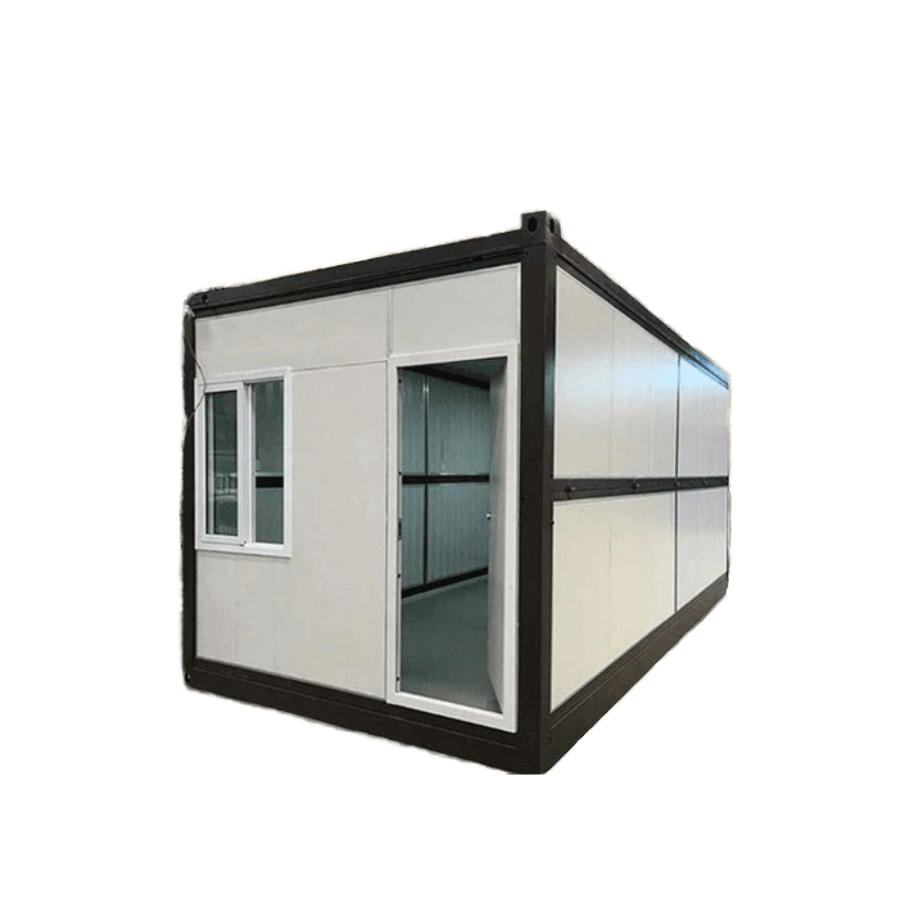
1. Highly Integrated Production Process
The container house assembly line integrates the dispersed construction processes at traditional construction sites into standardized processes within the factory. Taking a smart factory in Guangdong as an example, the house is disassembled into six components: the bottom, top, and four sides, which are produced simultaneously on multiple sub-assembly lines. Welding, assembly, and grinding are carried out collaboratively by robots, while AGV (Automated Guided Vehicles) are responsible for material transportation, ultimately assembling the complete box at the end of the assembly line. This parallel operation mode enables a daily module production capacity of up to 50 units, ten times that of similar factories in North America, with manufacturing precision consistently controlled within 1-2 millimeters.
2. Low-Carbon Circulation Throughout the Life Cycle
Modular houses are constructed using materials such as steel frames paired with fire-resistant rock wool sandwich panels, integrating insulation, fire resistance, sound insulation, and waterproofing into a single unit, supporting multiple disassembly and reuse cycles. Under standardized use and regular maintenance, leading compliant products can achieve an average of over 8 disassembly and reuse cycles, reducing construction waste emissions by approximately 90% compared to traditional fixed temporary buildings and significantly improving resource utilization. For example, in the modular hotel project by China Construction Science & Industry Group in Papua New Guinea, through standardized factory production and rapid on-site assembly, the overall delivery cycle was shortened from the traditional 14-18 months to 7 months, while reducing ground material consumption by 60-70%.
3. Cross-Border Compliance and Scenario Adaptation
Products produced by the container house assembly line must meet domestic and international certification standards, such as compliance with the GB50011-2010 Building Seismic Design Code and passing core performance tests for wind and earthquake resistance. Taking the products of Suzhou Zhongnan Steel Structure Co., Ltd. as an example, their all-steel structural frames exhibit a maximum deformation of only 2mm under the force of a Level 12 strong wind, well below the national standard limit. Additionally, modular houses can be adapted to diverse scenarios such as engineering camps, mobile commerce, cultural and tourism accommodations, and emergency support through customized exterior facades and internal functional modifications, meeting the high-efficiency, high-integration, and cost-effective demands of overseas clients.
4. Technology-Driven Industrial Upgrading
Domestic enterprises are driving industrial upgrading through independent research and development of key technologies. For example, the MiC (Modular Integrated Construction) technology developed by China Construction HaiLong Technology Co., Ltd. divides buildings into modular units, completing 90% of production work in the factory, and enabling rapid assembly on-site through reliable connection technologies. This technology has been applied in fields such as schools, dormitories, healthcare, and hotels, with a total project area exceeding 600,000 square meters, and relies on a 'digital delivery' system to ensure full-process quality control and traceability.



