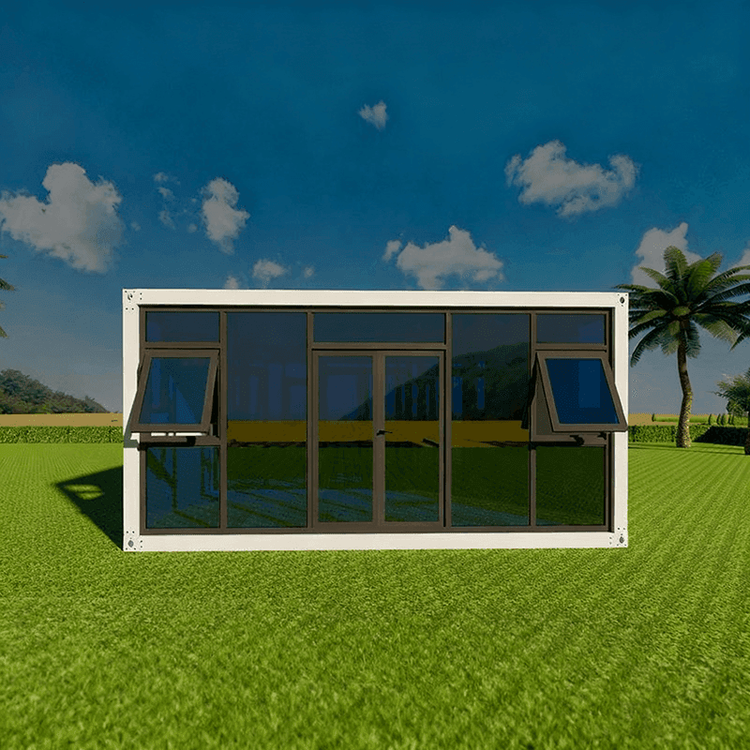
Container House
A container house is a building form made with dedicated container panels and processes, offering mobility, fast assembly, safety, and durability.

Features and advantages
Shipping volume for container houses can be compressed to under 50% of the original volume. The main structure is steel-framed, wind- and earthquake-resistant, and corrosion-resistant. Its cavity thermal-break design supports sound and heat insulation. Exterior styles are flexible and varied; units can be stacked and adapted to many size needs. With a modular layout, each unit can cut ocean-freight cost by nearly 40%. Advantages include faster build than conventional construction, lower cost than renting, mobility, durability, easy assembly, and being eco-friendly, flexible, and low-cost. Setup is as convenient as moving house: order today, deliver to site tomorrow, and finish install and move-in within three days—ideal for tight-schedule projects. Some units can last 50 years.
Application scenarios
They are common on construction sites as worker dormitories and temporary offices; also used to set up medical stations quickly in earthquake zones and highland outposts; and in commercial settings such as 24-hour gyms, trendy bubble-tea shops, and container guesthouses. In 2026, the Nagoya Asian Games in Japan used container housing for the Athletes' Village to cut event costs; the same year, a distinctive container guesthouse scenic area appeared in Shanting District, Zaozhuang, Shandong, China; in emergency medical facility construction, container houses play an important role thanks to rapid deployment. There are also compact 2 m × 3 m units that work as small storage rooms or mini kitchens.
Buying tips
Watch fire performance closely when choosing a unit—foam sandwich cores are cheap but hazardous; rock-wool fill is preferable. At the seaside or in high winds, reinforce and secure the unit. If heat is a concern in summer, choose newer insulation materials. On price, rental is about $0.6-$1.11 per day, and purchase starts at $972; prefer major makers such as Peng'an that commit to on-site repair within 72 hours.
Technical upgrades
Ongoing optimization and research cover insulation performance, energy supply systems, and smart management. For heating and power, early solutions combined solar heating with air-source heat pumps, later upgraded to new photovoltaic–thermal panels and underfloor heating, improving environmental performance and cutting carbon emissions.