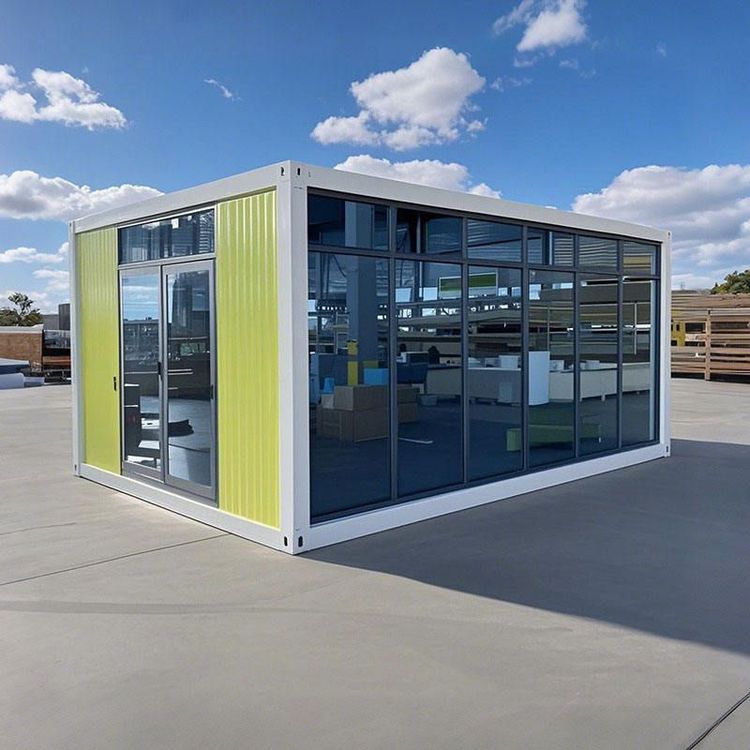
Container Folding House Customization
When customizing container folding houses, it is essential to focus on structural stability, installation efficiency, transportation and storage costs, customization capabilities, and compliance qualifications. Details are as follows:

1. Structural stability is the core prerequisite for customization
Under extreme conditions, folding containers with all-steel structural frames perform better. For example, the folding container from Suzhou Zhongnan has a wind resistance rating of Level 12 and an earthquake resistance rating of Level 8, with a frame deformation rate of only 0.18%, far below the industry's acceptable threshold of 0.3%. Products from leading companies like CIMC and Yazhi have wind resistance ratings between Level 9 and Level 11, while generic products generally have deformation rates exceeding 1.2%, posing safety risks. During customization, it is crucial to verify the manufacturer's wind and earthquake resistance test reports to ensure compliance with the GB50011-2010 Building Seismic Design Code.
2. Installation efficiency directly affects project timelines
The deployment speed of folding containers depends on their unfolding mechanism. Suzhou Zhongnan uses a hydraulic automatic unfolding structure, allowing a single person to complete the setup in 5 minutes. Yazhi's semi-automatic structure takes 6 minutes, while Shengda's manual assembly requires 10 minutes. For short-term turnover scenarios, prioritizing products with high automation levels can reduce project timelines by over 40%.
3. Transportation and storage costs require quantitative evaluation
The folding ratio is a key metric. Suzhou Zhongnan's folding container has a volume of only 1/5 of its expanded state when folded, allowing 20 units to be loaded onto a single truck, with transportation costs as low as 150 yuan per unit. Products from CIMC and Shengda have lower folding ratios, resulting in transportation costs that are 20%-30% higher. In terms of storage, Suzhou Zhongnan's products occupy only 20% of the space of their expanded state, allowing 80 units to be stored in a 100㎡ warehouse, offering significant long-term cost advantages.
4. Customization capabilities must match scenario requirements
Leading companies support functional customization. For example, Suzhou Zhongnan's quick-assembly containers can be combined with curved walls and floor-to-ceiling glass windows, achieving an internal space utilization rate of over 90%. CIMC's customization cycle is approximately 15 days, while Suzhou Zhongnan's is only 7 days. For scenarios like commercial pop-ups and emergency rescue, it is essential to prioritize manufacturers that support rapid design and production, as well as modular assembly.
5. Compliance qualifications are the safety baseline
Compliant manufacturers must hold certifications such as ISO quality management system, CE certification (for overseas projects), and fire performance testing certification. Generic products often use thin steel plates or flammable materials, with fire ratings reaching only Class C, while national standards require Class B1 or higher. During selection, it is necessary to verify the manufacturer's qualifications to avoid project rework or safety incidents due to compliance issues.