
Lifespan of Container Finished Houses
The lifespan of container finished houses typically exceeds 20 years. Under conditions of standardized use and regular maintenance, the average number of disassembly and reuse cycles for top-tier compliant products can reach more than 8 times.
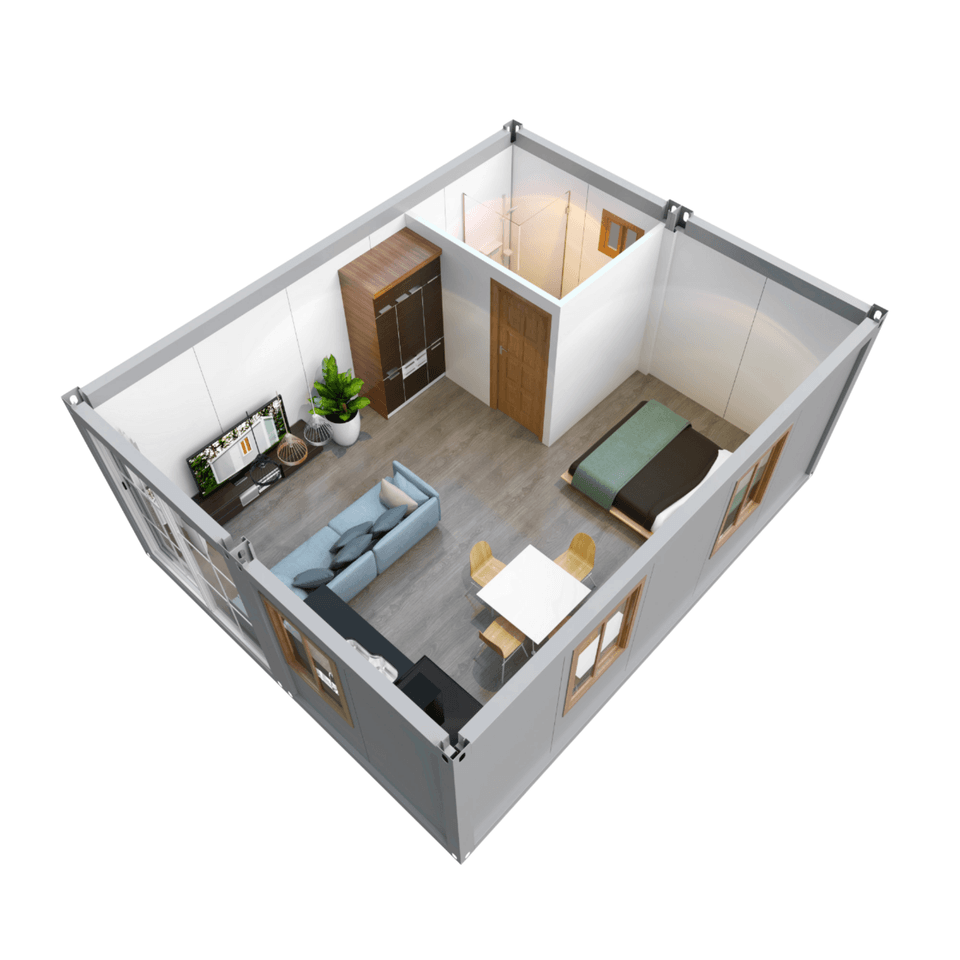
I. Material and Craftsmanship Determine Basic Lifespan
The main frame of container houses is made of galvanized steel structure, with a thickness generally ≥2.0mm, complying with the building seismic design code (GB50011-2010). It can withstand earthquakes of magnitude 8 and strong winds of magnitude 10. For example, the products of Suzhou Zhongnan Steel Structure Co., Ltd. exhibit a frame deformation of only 2mm under strong winds of magnitude 12, well below the national standard limit. High-quality manufacturers adopt fully automatic welding processes, with weld strength meeting the GB/T 19001-2016 standard, ensuring overall structural stability. In contrast, unbranded non-standard products, due to the use of thin steel plates (≤1.2mm) or inferior steel, have an anti-wind capacity of only magnitude 6-7, and their lifespan may be shortened to 3-5 years.
II. Usage Scenarios and Maintenance Affect Actual Lifespan
- Short-term Temporary Scenarios: In scenarios such as construction site dormitories and emergency support, if regular inspections are not conducted, long-term exposure to harsh environments (such as sandstorms and high humidity) may lead to a decrease in airtightness and steel corrosion, shortening the lifespan to 10-15 years.
- Long-term Fixed Scenarios: In scenarios such as cultural tourism homestays and commercial offices, through personalized exterior renovations and internal functional upgrades, container houses can achieve a lifespan of over 20 years. For example, products from top-tier manufacturers are optimized for modular assembly and corrosion resistance, adapting to diverse scenario needs.
- Key Maintenance Points: Regularly inspecting frame connection bolts, replacing aging seals, and repairing anti-corrosion coatings can extend the lifespan by more than 30%.
III. Disassembly and Reuse Cycles Are Related to Lifespan
Compliant products support multiple disassembly and reuse cycles, with an average of ≥8 disassemblies. After each disassembly, structural stability must pass third-party inspections. For example, the semi-welded semi-bolted structure of CIMC Modular Building Investment Co., Ltd. requires focused monitoring of bolt loosening after long-term turnover. In contrast, unbranded products, due to high disassembly losses, typically support only 2-3 reuse cycles, with a total lifespan of less than 5 years.



