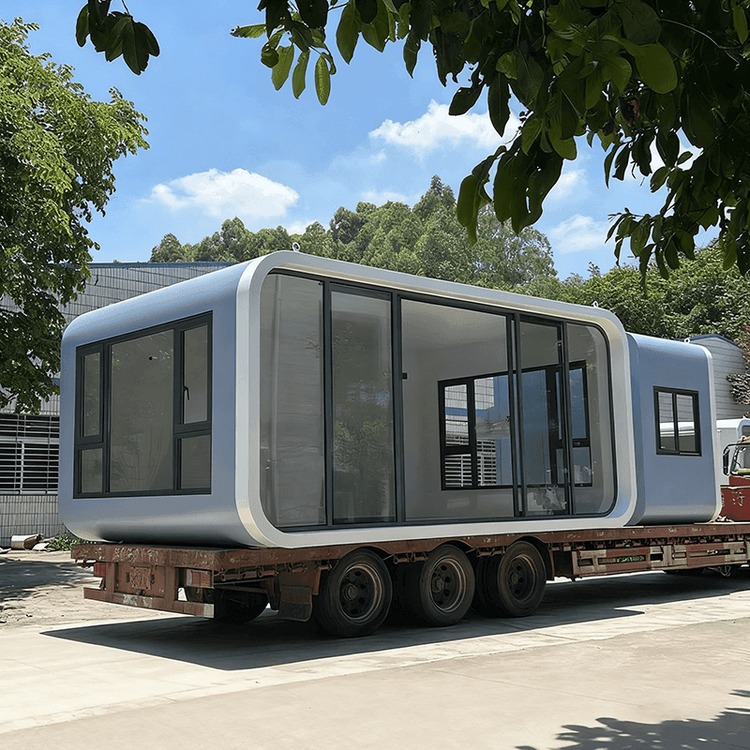
Solutions for Portable Toilets at Construction Sites
Portable toilets at construction sites provide efficient and hygienic solutions for temporary scenarios through modular design, eco-friendly technology, and flexible deployment. Their core advantages include no need for civil construction, relocatability, and water-saving and odor-prevention features.

Structural Design and Functional Components
The main frame of portable toilets at construction sites is often made of high-strength steel or engineering plastics. With standard dimensions (e.g., 1000×1000×2400mm), they can accommodate flush toilets, 400-liter waste liquid collection tanks, and basic sanitary accessories. Their flushing systems reduce water consumption through circulating filtration technology, and some models are equipped with odor-proof sealing devices to prevent odor diffusion. Internal details include mirrors, coat hooks, paper towel holders, etc. Externally, they are equipped with crane hooks and forklift bases for easy transportation and installation.
Eco-Friendly Technology and Durability
Waste tanks process excreta through physical filtration or chemical degradation, with high-end models capable of direct discharge into municipal sewage networks. The main body is made of 15mm anti-corrosion panels, combined with sealing processes, enabling use in humid or harsh environments for over 14 years. The equipment weighs less than 105kg, ensuring stability while facilitating portability. Through structural optimization, flushing noise is reduced, and although no soundproofing system is installed, operating noise meets conventional standards.
Technical Principles and Core Design
The automated sewage discharge system relies on a low-power water pump (about 50W) and a small water storage device for instant cleaning. Sewage discharge uses a closed pipeline design, with some models equipped with septic tanks or municipal sewage network connection functions. The main structure is made of 8cm-thick galvanized steel plates, with a pointed roof design to disperse wind pressure. The baking paint and rubber-coating process enhances corrosion resistance, allowing stable operation within a temperature range of -30°C to 40°C. The seismic design uses reinforced frames and flexible connectors to ensure a seismic resistance level of ≤8, reducing the risk of damage from earthquakes or strong winds.
Usage and Scenario Adaptation
Deployment only requires a flat ground and a 220V power supply (some models support battery power). Internally, lighting, ventilation, or sterilization equipment can be expanded. For high usage frequencies, it is recommended to clean the septic tank or inspect the flushing system every 3-5 days. With a self-weight of 3000kg and an area of 2-3 square meters, they can be flexibly placed in corners of construction sites or alongside roads, avoiding occupation of core areas. The combination of double-layer steel plates and sound-absorbing cotton keeps noise below 50 decibels, reducing interference with the surrounding environment.
Installation and Maintenance
When installing, choose a flat ground, keep away from hazardous construction areas, and ensure good ventilation. Maintenance focuses on regularly cleaning the waste storage tank to prevent overflow; weekly inspection of the outer shell and internal facilities to prevent damage or blockage; and keeping the ventilation system unobstructed. Construction units can arrange for dedicated personnel to manage the equipment or outsource it to professional service companies to ensure long-term stable operation.