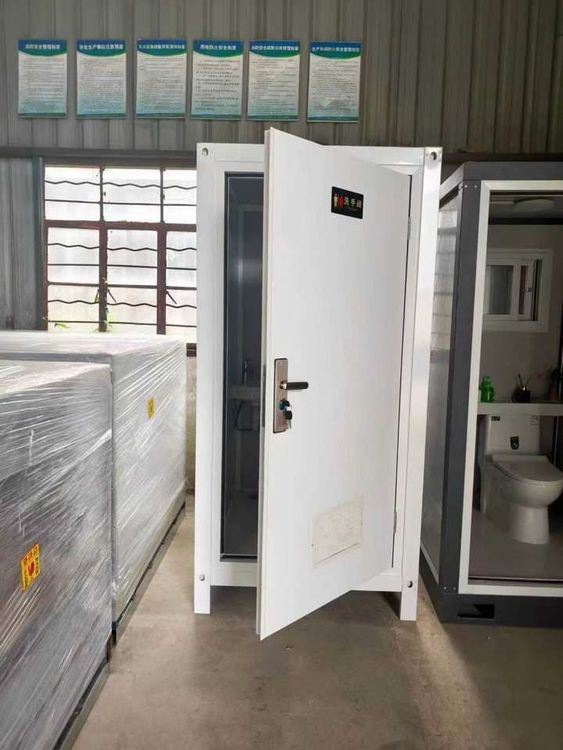
Flooring Materials for Portable Toilets on Construction Sites
Common flooring materials for portable toilets on construction sites include non-slip patterned aluminum plates, rubber flooring, vitrified tiles, and some high-end versions also feature fiberglass reinforced plastic (FRP) anti-corrosion layers on the chassis.

Non-slip patterned aluminum plates: These are one of the more common flooring materials for portable toilets on construction sites. Their surfaces feature non-slip patterns that effectively increase friction, preventing users from slipping and falling when entering or exiting the toilet or using it due to wet floors, ensuring personnel safety. Meanwhile, aluminum plates inherently possess good resistance to acid and alkali corrosion. Given the complex environment of construction sites, where various chemicals may be encountered, this characteristic enables non-slip patterned aluminum plates to be used for extended periods without easy damage, prolonging the service life of the flooring material.
Rubber flooring: It is also widely used in portable toilets on construction sites. Rubber flooring offers excellent non-slip performance, and its soft texture provides better friction, further reducing the risk of slipping. Moreover, rubber flooring is also resistant to acid and alkali corrosion, enabling it to adapt to the variable environment of construction sites. Additionally, rubber flooring has a certain degree of elasticity, making walking on it more comfortable and reducing fatigue from prolonged standing or walking.
Vitrified tiles: Some portable toilets on construction sites use vitrified tiles as flooring material. The surface density of vitrified tiles is superior to that of ordinary tiles, enabling them to reduce the penetration of sewage. During the use of portable toilets on construction sites, sewage splashes are inevitable. If the flooring material has high permeability, sewage will seep into the ground, making cleaning difficult and prone to generating odors. Vitrified tiles can effectively prevent this situation, reducing the likelihood of odor residue and maintaining fresh air inside the toilet.
Fiberglass reinforced plastic (FRP) anti-corrosion layer: In some high-end portable toilets on construction sites, an FRP anti-corrosion layer is added to the chassis. FRP has excellent anti-corrosion properties, capable of preventing leakage and odor leakage. It forms a sealed barrier, preventing sewage and odors inside the toilet from spreading to the surrounding environment, ensuring the cleanliness of the construction site environment and avoiding the impact of odors on nearby personnel.