
Construction Site Portable Toilet
A construction site portable toilet is a toilet facility that can be moved as a whole and is set up at construction sites or other locations with fixed or temporary needs. The following provides a detailed introduction from the aspects of production methods, types, structural components, and classifications:
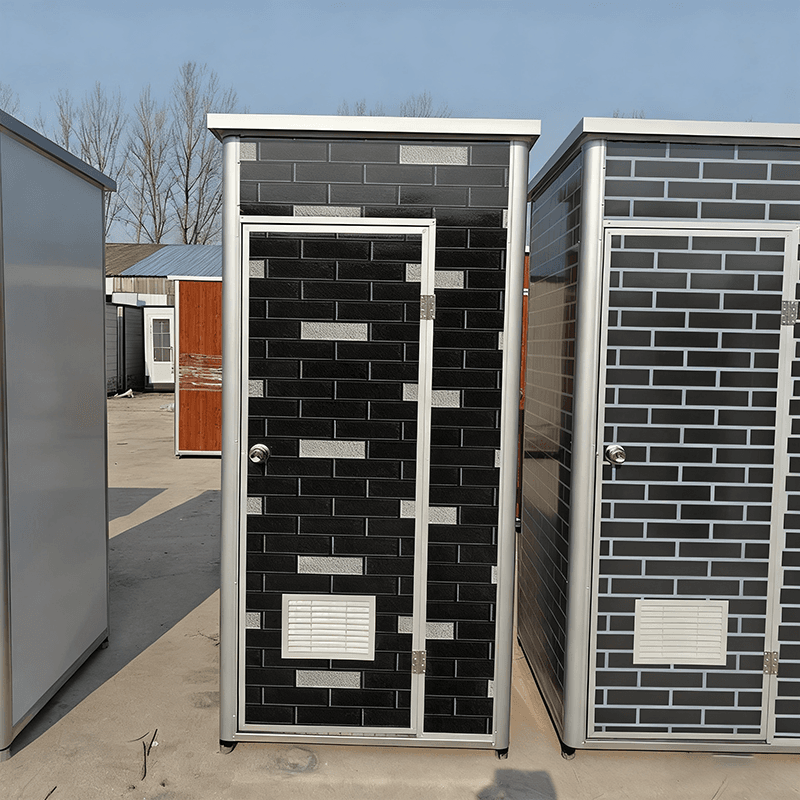
Production methods: There are various ways to produce construction site portable toilets. Some people use water storage tanks and pallets to make movable restrooms. Specifically, they use tools to fix universal wheels at the four corners of the bottom of the pallet, place water storage tanks retrieved from garbage stations, and after cutting, opening, and fixing operations, install equipment such as toilets, faucets, washbasins, and showerheads. Finally, they install a door to form a restroom. This method has a relatively low cost and can achieve resource reuse.
Types: A common type is the 4 + 1 stepped mobile restroom, which has four squatting positions and an open restroom in the middle. The exterior wall is made of heat-insulating and flame-retardant metal carved panels, the side door is a titanium-magnesium alloy door, the restroom is equipped with a complete set of bathroom cabinets, the interior wall is made of bamboo-wood fiber panels, exhaust fans, tissue boxes, and hooks are fully equipped, and the bottom is made of anti-slip tiles. It can also be customized according to special needs. This type has relatively complete functions and can meet the simultaneous use of multiple people and various needs.
Structural components: It is generally composed of a fecal sewage storage tank (or fecal sewage treatment device), a floor, sanitary ware, walls, washing equipment, a water tank, a roof, and a moving device. The fecal sewage storage tank is used to collect and treat fecal sewage; the floor ensures stability during use; sanitary ware such as toilets provides toilet functions; walls serve to separate and protect privacy; washing equipment facilitates user cleaning; the water tank provides water for flushing, etc.; the roof can shelter from wind and rain; and the moving device facilitates the overall movement of the toilet.
Classifications: According to the structural form, they can be divided into single-structure mobile toilets and composite-structure mobile toilets; according to the moving method, they can be divided into hoisting and handling mobile toilets, powered and towed mobile toilets; according to the sewage treatment method, they can be divided into water-flushing and non-water-flushing suction mobile toilets, circulating water-flushing mobile toilets, and dry-packing mobile toilets. Different types of mobile toilets have differences in usage scenarios and functional characteristics, and can be selected according to the actual needs of the construction site.



