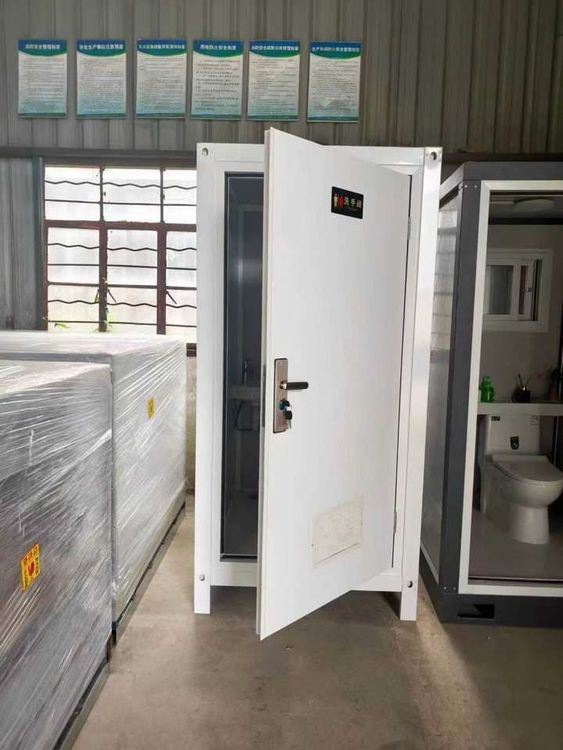
Portable Toilets for Construction Sites
Portable toilets for construction sites are facilities that can be moved as a whole and set up at construction sites and other locations to provide toilet services for workers.

I. Basic Components Portable toilets for construction sites generally consist of fecal sewage storage tanks (or fecal sewage treatment devices), floor slabs, sanitary ware, walls, washing equipment, water tanks, roofs, and mobile devices. They are relatively well-equipped and can be used immediately upon placement, and also support customization. For example, they are usually equipped with leakage switches, flush tanks, exhaust fans, lights, ceramic floors, etc., to ensure safety and comfort during use.
II. Main Advantages Portable toilets have many significant advantages. Firstly, they are highly mobile and can be easily transported to any construction site where toilets are needed, whether it is a new construction site or a temporary construction point, enabling rapid deployment. Secondly, they are combinable. Multiple portable toilets can be combined according to the actual needs and number of personnel at the construction site to form toilet areas of different scales. Thirdly, they are easy to transport. Their overall structural design facilitates loading, unloading, and transportation, reducing transportation costs and time costs. In addition, portable toilets can be used repeatedly, improving resource utilization and reducing usage costs.
III. Classification According to the structural form, portable toilets can be divided into single-structure portable toilets and composite-structure portable toilets. Single-structure portable toilets are relatively independent and have a simple structure; composite-structure portable toilets are composed of multiple parts and may have richer functions. According to the mobile method, they can be divided into lifting and handling portable toilets, and powered and towed portable toilets. Lifting and handling portable toilets are suitable for short-distance movement or when the site conditions allow lifting operations; powered and towed portable toilets can be moved over long distances by vehicle traction. According to the sewage treatment method, they can be divided into water-flush and waterless-flush suction portable toilets, circulating water-flush portable toilets, and dry-packing portable toilets. Water-flush and waterless-flush suction portable toilets are suitable for sites with a water source or where it is convenient to suction feces; circulating water-flush portable toilets can save water resources; dry-packing portable toilets do not require a water source and are suitable for water-scarce areas or temporary use.