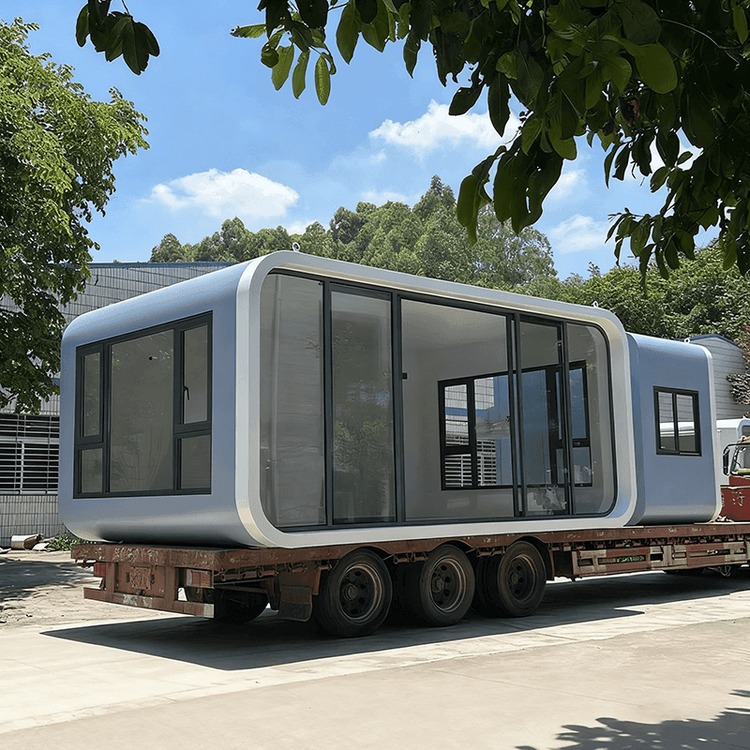
Construction Site Mobile Prefab Toilet
Construction site mobile prefab toilets come in various types and features, allowing for selection and customization based on different needs.

I. Self-made Mobile Toilets Some construction sites adopt simple self-made solutions, utilizing modified water storage tanks and pallets. By fixing universal wheels at the bottom of the pallet, mobility is achieved. The modified water storage tank is connected to facilities such as toilets, faucets, and washbasins, forming a basic sanitation unit. This design is relatively low-cost but has limited functionality, making it suitable for temporary and small-scale construction sites. Regular maintenance of the cleanliness and sealing of the water storage tank is required.
II. Eco-friendly Mobile Toilets In response to the environmental needs of construction sites, eco-friendly mobile toilets have become a mainstream choice. For example, the 4+1 stepped mobile toilet includes four squatting positions and one open washroom. Its exterior walls are made of heat-insulating and flame-retardant metal carved panels, and the side doors are made of titanium-magnesium alloy, ensuring both durability and safety. The interior is equipped with a complete set of bathroom cabinets, non-slip tile floors, exhaust fans, and tissue boxes, enhancing user comfort. These toilets can be customized according to special needs such as the number of workers and gender ratios at the construction site, such as adjusting the number of squatting positions or adding barrier-free access.
III. Enterprise-customized Mobile Toilets Some enterprises offer customized services based on the composition characteristics of workers at factories or construction sites. For example, a company designed a mobile toilet for a factory, setting up seven squatting positions for men and one for women based on the ratio of more men to fewer women, optimizing resource allocation efficiency. The customization process typically includes needs communication, design, manufacturing (with a production cycle of 7-15 days), and on-site installation. The main frame is made of steel, and the exterior wall materials can be galvanized steel plates, stainless steel plates, or aluminum plates. The interior is insulated with rock wool or polyurethane, and the floor is laid with non-slip flooring and a waterproof layer to ensure adaptability to the complex environment of construction sites.
IV. Modular Mobile Toilet Systems Professional enterprises offer both single-unit and modular mobile toilet products. Single-unit toilets are suitable for areas with dispersed foot traffic, while modular toilets can be combined to form multi-toilet units equipped with washbasins, urinals, and other facilities. For special needs, barrier-free mobile toilets, eco-friendly toilets (such as those using microbial degradation technology), or luxury mobile toilets (with added air conditioning and fresh air systems) can also be developed. These products are widely used in industrial parks, construction sites, and other locations, with easy installation and quick commissioning after connecting to water and electricity supplies.