
Construction of Mobile Toilets
Mobile toilets can be designed and constructed according to different needs and creative ideas, with various types and design considerations.
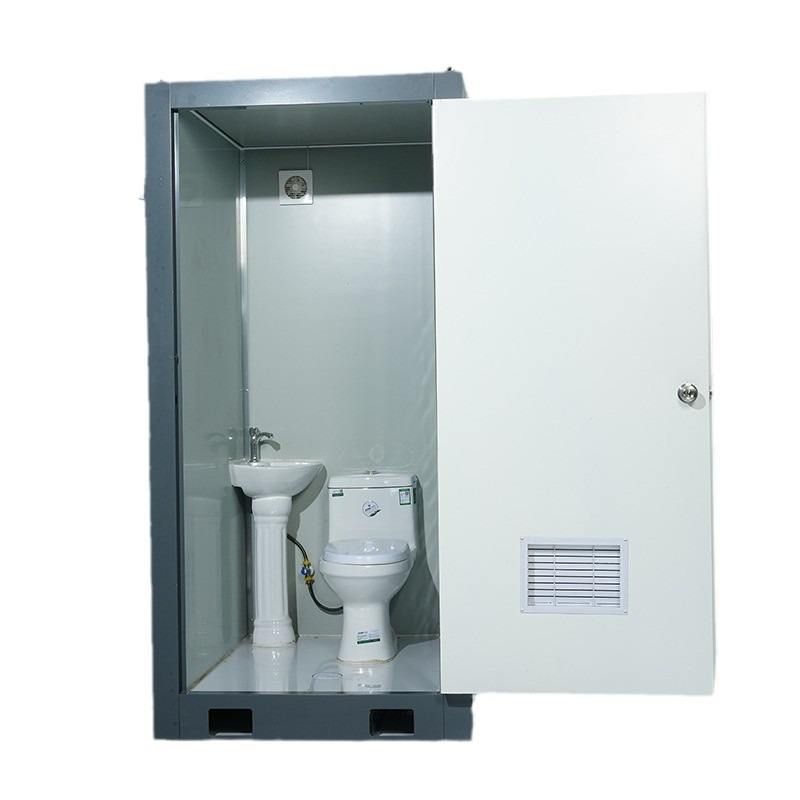
Common Construction Methods
Some people use water storage barrels to make portable restrooms. The specific steps are as follows: First, split the water storage barrel in half lengthwise, and fix universal wheels at the four corners of a wooden board for easy movement. Use wooden strips to increase the height of the barrel, cut an opening on the side and install a door frame, and embed plastic soft panels to form the walls. Use the upper half of the water storage barrel as the roof, cut a hole at the bottom of the barrel to install a drain pipe to form a floor drain, and cut holes on the side to connect interfaces for installing facilities such as toilets, water tanks, bath heaters, and washbasins.
Components of Mobile Toilets
Generally, they consist of a fecal sewage storage tank (or fecal sewage treatment device), flooring, sanitary ware, walls, washing equipment, water tanks, roofs, and mobile devices.
Classification of Mobile Toilets
- By structural form: They can be divided into single-structure mobile toilets and composite-structure mobile toilets. Single-structure mobile toilets are relatively simple and independent, while composite-structure mobile toilets are more complex and may be composed of multiple parts.
- By mobility method: They are classified into hoisting and handling mobile toilets, and powered and towed mobile toilets. Hoisting and handling mobile toilets mainly rely on human power or simple machinery for movement; powered and towed mobile toilets are moved using power devices or vehicles.
- By sewage treatment method: They are divided into water-flush and non-water-flush suction mobile toilets, circulating water-flush mobile toilets, and dry-packing mobile toilets. Water-flush and non-water-flush suction mobile toilets treat fecal sewage through water flushing or suction; circulating water-flush mobile toilets can recycle the flushing water; dry-packing mobile toilets pack and treat feces without using water.
Design Principles
The design should adhere to the principles of mobility and convenience, economic durability, environmental protection and ecological friendliness, and enhancing efficiency and promoting humanity. The overall structure should be lightweight, using lightweight and durable materials as much as possible, and the structure should be sturdy. At the same time, the height and width of the toilet should be controlled during design, and the mobile device should be fully considered for completeness and rationality. For example, a 30-square-meter mobile toilet may adopt a galvanized frame structure with a仿木纹 (wood-grain-like) metal carved panel for the exterior walls, providing both insulation and heat resistance. It may have two arc-shaped translucent windows at the front and include functional areas such as a public washing area and a management area.



