
Compact Container Houses
Compact container houses use containers as basic structural modules and, after conversion, form livable or office buildings that are quick to build, flexible and eco-friendly, and low-cost—widely used for temporary housing, creative spaces, emergency buildings, and commercial innovation.
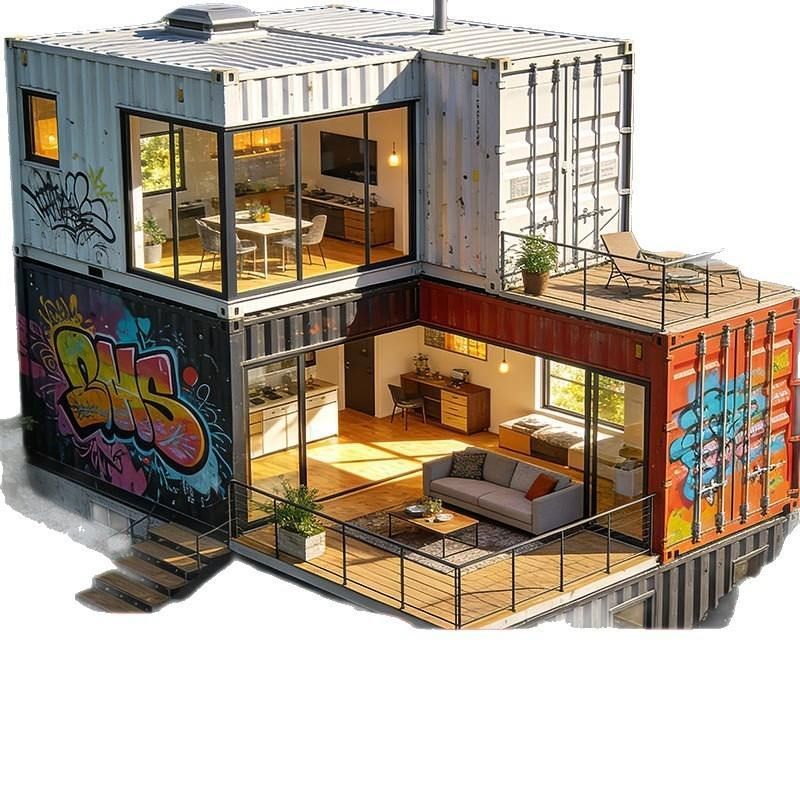
Build process and structural traits
Construction starts from standardized containers as modules, stacked or staggered and weld-reinforced into a stable frame, then finished with door/window openings, partitions, and MEP. The core strength is modular design: the container’s high-strength, corrosion-resistant steel frame serves directly as the load-bearing system, skipping many masonry or frame steps of traditional builds. Stacking raises story height; side-by-side joining expands floor area for different scenarios. Upgraded insulation (rock-wool board, polyurethane foam) markedly improves thermal comfort year-round.
Core advantages
- Efficiency and flexibility: Prefabricate in the factory, ship, and assemble on site to cut schedules sharply; relocation only requires dismantling modules for reuse—ideal for temporary housing and post-disaster emergency use.
- Green and economical: Converting recycled containers cuts construction waste and material cost versus traditional builds; modular production reduces labor and overall cost.
- Functional adaptability: Interior partitions flexibly create living, office, or commercial zones; MEP covers basic needs; some premium cases add solar panels and smart controls.
Typical applications
- Temporary facilities for large events: e.g., the 2026 Asian Games in Nagoya, Japan, used container houses for the Athletes’ Village for fast, green deployment.
- Cultural-tourism creative spaces: Shanting District, Zaozhuang, Shandong, China, built distinctive homestay scenic areas with personalized finishes.
- Emergency medical facilities: In epidemics or disasters, containers convert quickly into cabin hospitals and isolation wards for efficient medical resource allocation.
- Commercial innovation: Brands convert containers into 24-hour self-service fitness cabins, mobile cafés, and other “asset-light” models.
Innovation extension: mobile container homestays
These designs strengthen mobility with small modules (e.g., 20-ft standard boxes), fitted with beds, baths, and AC, exteriors painted or dressed to blend with nature. A key benefit is not consuming land quotas; trailers can move them to scenic spots or camps for short stays while avoiding complex approvals of traditional homestay construction.



