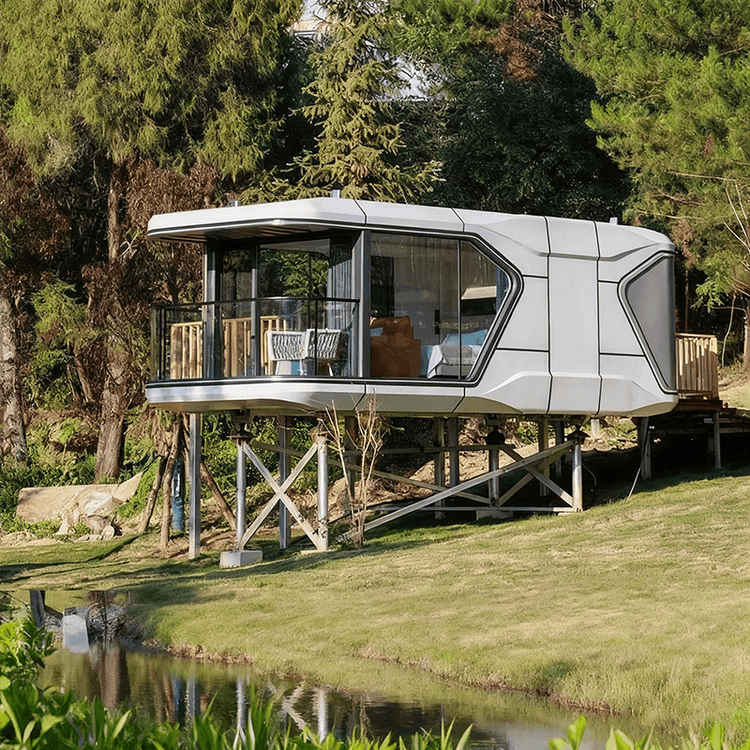
Commercial Use of Container Houses
Container houses have a wide range of commercial applications, covering creative spaces, pop-up businesses, characteristic commercial districts, temporary facilities, and innovative applications, among others.

1. Creation of Creative Commercial Spaces
Through modular cutting and reassembly, container houses can quickly construct low-cost, highly flexible commercial spaces. For example, a creative park in Shanghai utilized 200 second-hand containers to complete the renovation of a stepped office area, an open-air theater, and a vertical green wall within three months, reducing costs by 35% compared to traditional steel-structured buildings. Their highly malleable structures support multi-level stacking and open layouts, making them suitable for art exhibitions, co-working spaces, and other scenarios.
2. Pop-up Stores, Online-Famous Homestays, and Mobile Exhibition Halls
The "plug-and-play" nature of container houses makes them ideal carriers for pop-up businesses. A cultural tourism town in Chengdu transformed packing boxes into boutique homestays with 15 different unit types through standardized modular combinations, keeping the cost per unit under 80,000 yuan. Prefabricated decoration technology enabled on-site installation in just two days, significantly shortening the opening cycle. A chain coffee brand utilized container mobile stores for rapid nationwide expansion, reducing the preparation cost per store by 60%. Additionally, container exhibition halls can be quickly disassembled and reassembled to meet the needs of different exhibitions.
3. Characteristic Commercial Districts
Container commercial buildings can be adapted to urban commercial areas, cultural tourism attractions, and other scenarios, creating low-cost, highly recognizable commercial landmarks through customized design. Their exteriors support full-dimensional customization, such as color, shape, and facade style, combining factory prefabrication with on-site assembly to enable operation within weeks. The districts can integrate online-famous snacks, themed dining, open-air leisure areas, and other business formats, forming a closed loop of "shopping, eating, playing, and taking photos" to attract young consumer groups.
4. Temporary Commercial Facilities
Container panel houses are widely used in temporary commercial scenarios. Urban pop-up stores attract pedestrians with their unique appearances and quickly create a commercial atmosphere with interior displays. In tourist attractions, container stores and snack stalls blend into the overall style, serving both functional and landscape purposes. At music festivals, exhibitions, and other events, containers can serve as temporary sales points, rest areas, or information centers to meet short-term functional needs.
5. Innovative Commercial Applications
With technological advancements, the application boundaries of container houses continue to expand. For example, by 2026, some brands had already transformed them into 24-hour self-service fitness pods, achieving unmanned management through intelligent equipment and reducing operational costs. In the future, containers may further integrate into emerging fields such as the sharing economy and unmanned retail, becoming important carriers for commercial innovation.