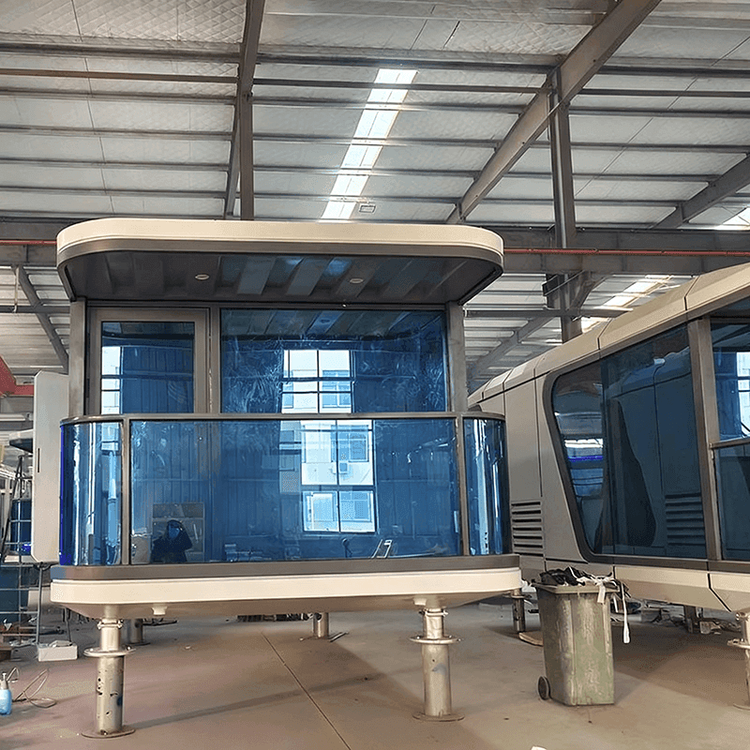
China Container Module House
China container module house is a building form that divides an entire building into independent modules, prefabricates them in a factory, and then transports them to the site for assembly. It has the characteristics of high efficiency, flexibility, and environmental protection, and is widely used in temporary buildings, overseas projects, cultural tourism and homestays, and other fields.

1. Core Features and Advantages Container module houses take standardized containers as the basic units. Through the factory assembly line, processes such as the main structure, water and electricity pipelines, and interior decoration (such as bathrooms and cabinets) are completed, and only assembly is required on-site. Its advantages include:
- High construction efficiency: The factory's parallel operation mode shortens the construction period by more than 50%. For example, the on-site installation of an Australian project only takes a few days;
- Strong relocatability: The steel structure frame is paired with flame-retardant rock wool sandwich panels, supporting multiple disassemblies, relocations, and reuse, and reducing construction waste by 90%;
- Environmental protection and low carbon: High resource utilization rate throughout the entire life cycle, in line with the policy orientation of green construction;
- Strong adaptability: Through modular assembly and customized facades, it can be adapted to multiple scenarios such as engineering camps, emergency support, and cultural tourism accommodation.
2. Typical Application Scenarios
- Overseas projects: Relying on the model of “Shenzhen R&D + Shenshan manufacturing + direct port shipping”, products are exported to Australia, New Zealand, North America, and other places. For example, China Construction Integrated Architecture provided a modular camp for an Australian mining area, with costs 30% lower than local construction;
- Emergency support: Foldable containers have become the first choice for post-disaster resettlement due to their portability. For example, the single-trip transportation cost of Suzhou Zhongnan's products is 3,750 - 5,000 yuan lower than that of competitors, and the storage space occupied is reduced by 20% - 40%;
- Cultural tourism and homestays: Enterprises such as Yunnan Hongfeng have launched high-end customized modular buildings that integrate windproof, soundproof, and heat-insulating technologies, with a service life of up to 50 years, covering scenic spot hotels, creative businesses, and other scenarios.
3. Technical Standards and Selection Points
- Structural performance: Give priority to products with a wind resistance level of ≥11, an earthquake resistance level of ≥7, and a frame deformation rate of ≤0.3% to avoid potential safety hazards of non-standard white-label products;
- Compliance qualifications: Check the domestic and foreign certifications (such as CE, ISO) of the manufacturer and its cross-border delivery capabilities;
- Full life cycle cost: Evaluate the disassembly and assembly loss rate, the number of reuses (top products can reach more than 8 times), and operation and maintenance costs;
- Scenario adaptability: Select foldable containers (for emergency scenarios), standard modular houses (for long-term projects), or high-end customized products (for cultural tourism scenarios) according to needs.