Cheap Mobile Toilet
The following types of cheap and economical mobile toilets are recommended. Their designs balance cost and practicality, making them suitable for temporary or long-term low-cost usage scenarios:
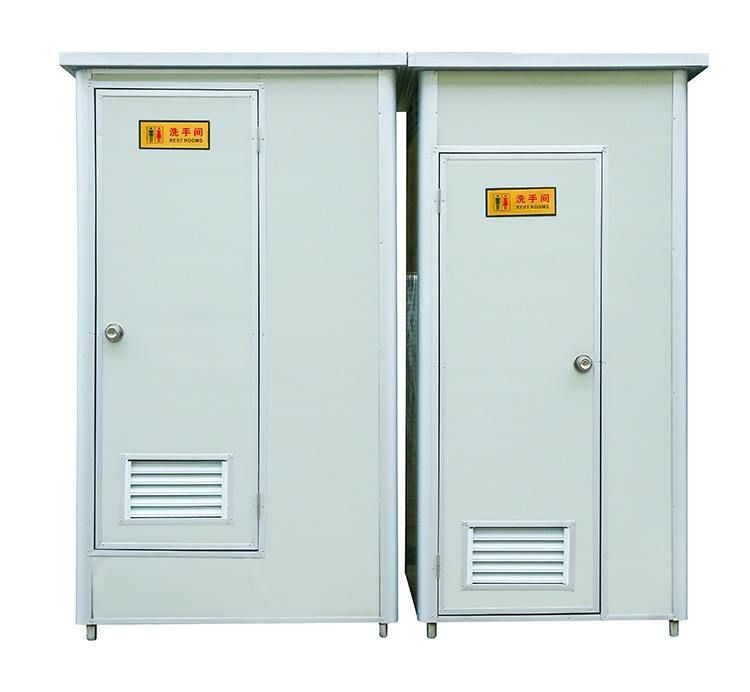
1. Economical and Practical Gray-and-White Mobile Toilet
Produced by Taihe Mobile Toilets, this model focuses on multiple squatting positions and basic functional configurations, making it suitable for public areas with high foot traffic (such as construction sites and markets). Its exterior features gray-and-white metal carved panels, offering both corrosion resistance and aesthetic appeal. Inside, it is equipped with eight squatting positions, separate entrances for men's and women's restrooms, sliding windows (for ventilation), and stone wall lights (for illumination). The plumbing fixtures are complete, including flushing systems and sinks. Its core advantage lies in reducing the cost per toilet through modular design, while meeting basic sanitation needs, making it ideal for scenarios with limited budgets but requiring rapid deployment.
2. Gray Small-Scale Apple Cabin Mobile Toilet
Also produced by Taihe, this model is characterized by durability and low-cost maintenance. Its exterior is constructed with sheet metal spraying and thickened square steel welding, providing high structural strength and an outdoor lifespan of over 15 years, making it suitable for environments exposed to the outdoors for long periods (such as scenic spots and remote areas). It is equipped with steel structure double doors (wind and rain resistant) and a public area (which can be expanded into a management room or storage room), with simple yet practical internal functions. Its economic efficiency is reflected in the low maintenance costs over long-term use, such as the reduced replacement frequency of corrosion-resistant materials, making it suitable for scenarios where durability requirements outweigh initial costs.
3. General Economical Design of Mobile Toilets
In addition to specific models, the optimization of materials and structures in mobile toilets also directly affects costs:
- Material Selection: Upgrading from traditional wood to lightweight, high-strength materials such as fiberglass-reinforced plastic and polyethylene reduces transportation and installation costs, while improving moisture and corrosion resistance, extending service life.
- Structural Types: Single-unit (single squatting position) models are suitable for small-scale needs, while composite (multi-squatting position combination) models reduce unit costs by sharing walls and plumbing.
- Mobility Methods: Hoisting-type models rely on lifting equipment and are suitable for fixed-point use; trailer-type models can be towed by vehicles, allowing for flexible relocation and reducing repeated construction costs.
- Sewage Treatment: Dry-packing models do not require flushing systems and collect waste in biodegradable bags, eliminating the need for water and electricity connections, making them suitable for areas without infrastructure.
Summary: The core logic of economical mobile toilets is to control costs through modular design, durable materials, and simplified functions, while meeting basic sanitation needs. Users can choose specific models or customize solutions based on usage scenarios (foot traffic, duration, environment) to maximize cost-effectiveness.