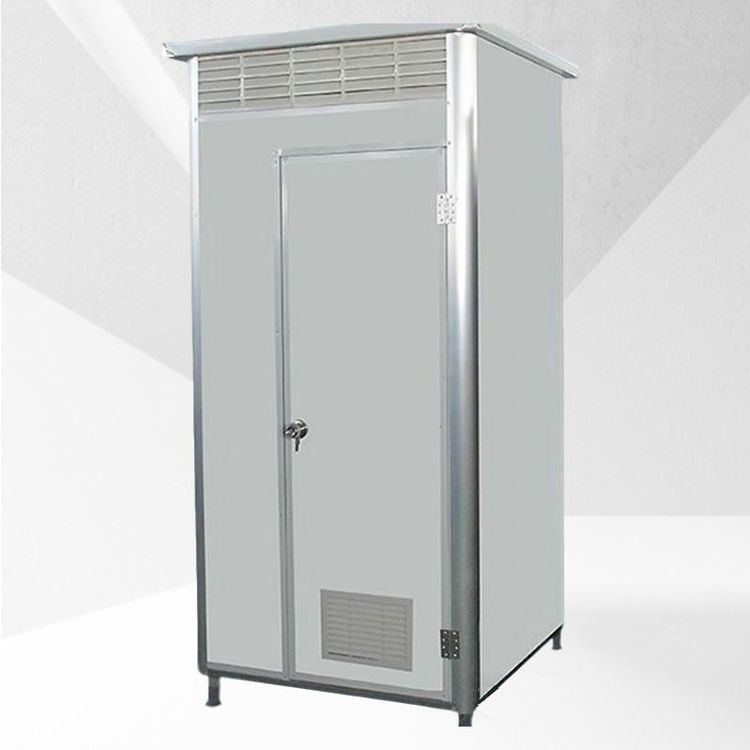
Chaoyang Mobile Toilet Outdoor
Chaoyang mobile toilets have significant advantages in outdoor settings, with their design, functionality, and service models highly suited to outdoor activity needs.

1. Rental Model and Land Resource Management
Chaoyang mobile toilets adopt a rental model, where service providers obtain operational rights and maintenance responsibilities for the facilities over a specified period through contracts, without requiring land ownership transfer. This model covers the entire lifecycle management of the facilities, including planning, manufacturing, installation, maintenance, and renewal and recycling, ensuring long-term stable operation in outdoor settings. For example, in large-scale sports events or garden festivals, the rental model allows for flexible adjustment of the number of facilities and usage duration, avoiding resource idleness or waste while reducing land resource occupation. After the event, the facilities can be entirely removed, and the site quickly restored to its original state, making it particularly suitable for phased construction areas or locations with significant pedestrian flow fluctuations.
2. Structural Design and Environmental Adaptability
The main structure of the facilities often uses polymer composites or high-strength engineering plastics, offering excellent weather resistance and corrosion resistance, capable of withstanding UV rays, wind and rain erosion, and temperature changes in outdoor environments. The integrated design reduces leakage risks and simplifies the installation process, enabling rapid deployment on complex terrains. For example, on uneven ground such as mountains or beaches, the modular structure can achieve stable placement by adjusting support components, ensuring safety during use.
3. Functional Configuration and Scene Adaptability
The modular design of mobile toilets supports on-demand configuration of functional modules. For instance, market events can add handwashing stations and waste sorting devices; sports events require barrier-free access and first aid kits; and母婴 (maternity and baby) scenarios can include diaper changing tables and private compartments. Internally, they are equipped with water storage tanks and small-scale septic tanks or biodegradation units, enabling water recycling or on-site waste treatment. Biodegradation technology uses microorganisms to decompose feces, reducing odors and pollution, meeting environmental protection requirements, and is particularly suitable for ecologically sensitive areas or water source protection zones.
4. Technological Iteration and Sustainability
During lease contract renewals, service providers introduce water-saving technology upgrades (such as sensor-activated faucets) and efficient waste treatment processes (such as membrane separation technology), enhancing resource utilization efficiency. Future development directions include using sensors to monitor usage frequency and cleaning needs in real-time, optimizing maintenance scheduling efficiency; strengthening the functional integration of facilities with urban public service nodes, such as linking with waste transfer stations or sewage treatment systems to form a resource loop. Currently, the industry is exploring greywater reuse and fecal resource treatment technologies, using treated water for greening irrigation and converting feces into organic fertilizer, further reducing environmental loads.