
Cement Board Container House
Cement board container houses are container-style movable houses constructed primarily with cement boards. They are known for their robustness, durability, fire and moisture resistance, and ease of assembly, making them widely used in construction site dormitories, temporary offices, commercial shops, and vacation homestays.
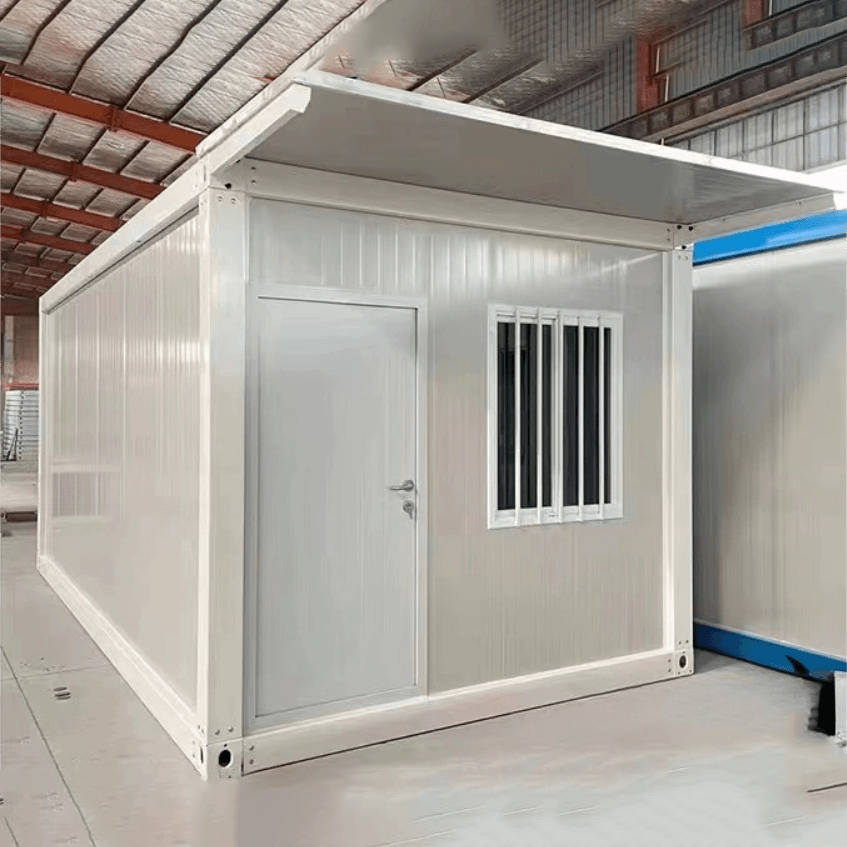
I. Material Characteristics and Advantages
The core material of cement board container houses is fiber cement board (also known as fiber cement pressure board). It is made with cement as the base material, to which mineral fibers and other reinforcing materials are added, and then pressed into shape by a 7000-ton press. This type of board has the following characteristics:
- Fire and Insulation Resistance: It has remarkable fire resistance and is commonly used in power distribution rooms and other areas with dense electrical usage.
- Moisture and Heat Insulation: It performs stably in humid environments and offers outstanding heat and sound insulation.
- Lightweight and High Strength: Despite its high density, it is lightweight, has strong load-bearing capacity, and is not prone to deformation or warping.
- Easy Construction: It is economical, aesthetically pleasing, safe, and harmless, with a lifespan of over 20 years.
II. Structural Types and Classifications
Based on cost and purpose, cement board container houses can be divided into two categories:
- Basic Movable Houses: These use large corrugated sandwich panels or flat sandwich panels with an iron sheet thickness of 0.2-0.8mm, filled with rock wool or foaming agents (those with poor fire resistance have been phased out). These houses are low-cost but have limited aesthetics and durability, and are mostly used in construction site dormitories and temporary warehouses.
- Custom Modular Houses: The outer wall layer is made of weather-resistant steel plates or galvanized steel plates (with a thickness of 1.2-3.0mm), with integrated insulation, sound insulation, and water and electricity systems in the middle. These houses balance functionality and aesthetics and are suitable for offices, commercial activities, and high-end homestays.
III. Application Scenarios and Cases
Cement board container houses, with their mobility, rapid assembly, and structural stability, are widely used in the following fields:
- Construction Sites: They serve as temporary dormitories, offices, or guardhouses, meeting basic living and office needs.
- Commercial Venues: They can be customized into coffee shops, stores, or exhibition spaces, supporting rapid deployment and flexible relocation.
- Vacation Homestays: By adding prefabricated concrete wall panels or metal carved panels on the exterior, they achieve a balance between industrial style and living comfort, such as the 'Stack' apartment project in London, UK.
- Emergency Scenarios: They serve as shelters or isolation rooms, providing safe and waterproof temporary living spaces.



