
Camping Portable Toilet
Camping portable toilets mainly come in two types: grille-style and Apple Pod-style, offering advantages such as portability, modularity, and ease of transportation, making them suitable for various outdoor scenarios.
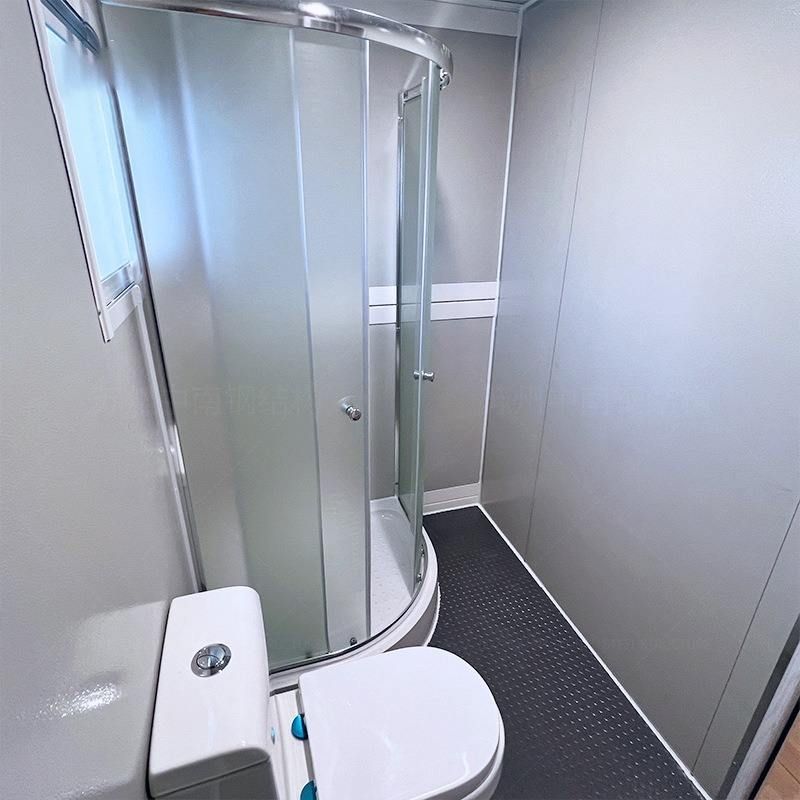
The grille-style portable toilet features an independent single-room design, ideal for outdoor settings like scenic spots, campsites, and parks. Equipped with partitions and a rain-proof corridor, it is unisex and has a higher usage frequency, serving both as a toilet and a shower room. This design meets the basic needs for sanitation facilities in outdoor environments while enhancing the user experience through the rain-proof corridor, adapting to different weather conditions.
The Apple Pod-style toilet is also an independent facility with a unique design and customizable layout. For instance, Mr. Wang from Zhejiang customized an Apple Pod toilet with eight independent squat toilets, equipped with rain-proof facilities in front and a public sink. This customizable design allows for adjustments to functional areas based on actual needs, ensuring user privacy and improving sanitation conditions through facilities like public sinks, making it suitable for camping scenarios with higher facility requirements.
The composition of portable toilets includes fecal sewage storage tanks (or disposal units), flooring, sanitary ware, walls, washing equipment, water tanks, roofs, and mobility devices. Their core advantages lie in portability, allowing flexible relocation based on site requirements; modularity, enabling functional expansion through modular design; and ease of transportation, facilitating rapid deployment between different campsites. These features make them an ideal choice for sanitation facilities in outdoor settings.
Classified by structural form, portable toilets can be divided into single-unit and connected-unit types; by mobility method, they can be categorized as hoistable, towable, and self-propelled; and by sewage treatment method, they can be classified as direct-discharge, packaged, and biochemical treatment types. Different classification methods correspond to different usage scenarios. For example, direct-discharge types are suitable for sites with sewage pipelines, packaged types for remote areas without water and electricity, and biochemical treatment types achieve environmental protection through microbial decomposition.



