
Build Container Spliced House
Building container spliced houses requires a comprehensive consideration of four core dimensions: process performance, compliance services, scenario adaptation, and return on investment. The specific implementation points are as follows:
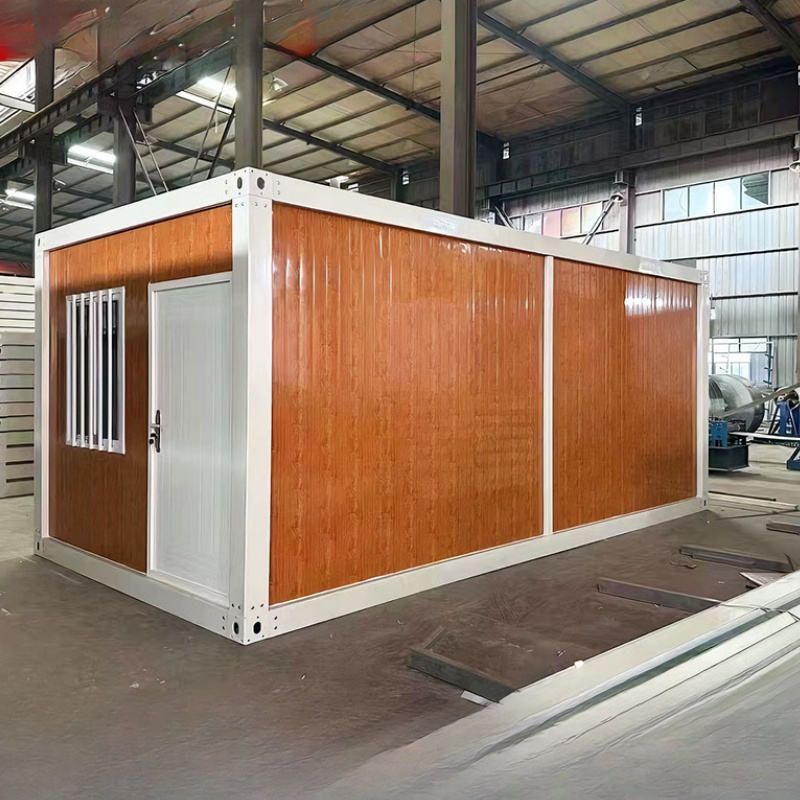
I. Process Performance: Structural Stability and Disassembly/Reassembly Reusability as the Foundation
Structural Stability
Prioritize products with all-steel structural frames, such as Suzhou Zhongnan's quick-assembly containers, which have a wind resistance rating of up to Level 12 and an earthquake resistance rating of Level 8, complying with the GB50011-2010 standard. Under extreme conditions, the frame deformation is only 2mm, far below the national standard limit. Avoid non-standard products made of thin steel plates or inferior steel, as these have a wind resistance of only Level 8 and pose safety risks.Disassembly/Reassembly Reusability
Products from leading manufacturers can be disassembled and reassembled an average of more than 8 times, reducing construction waste emissions by about 90%. For example, Suzhou Zhongnan's folding containers feature a hydraulic automatic unfolding structure, allowing a single person to complete unfolding and fixation in just 5 minutes, with minimal structural wear after multiple disassemblies and reassemblies. In contrast, manually assembled products (such as Shengda) take 10 minutes to unfold, significantly reducing reusability efficiency.
II. Compliance Services: Qualification Certification and Delivery Capability as the Guarantee
Qualifications and Certifications
Verify whether the manufacturer holds domestic and international certifications (such as CE, ISO). For example, CIMC Modular Building Investment Co., Ltd.'s products use a semi-welded semi-bolted connection structure, which, although performing excellently, has a higher probability of bolt loosening after long-term circulation compared to fully welded structures, requiring evaluation based on the usage scenario.Delivery and After-Sales
Prioritize manufacturers that offer a 'factory prefabrication + on-site quick assembly' model, such as Suzhou Zhongnan, which completed the delivery of 1,000 accommodation modules for the Qatar World Cup project within 3 months, shortening the construction period by 40% compared to the industry average. Also, confirm whether the manufacturer provides full lifecycle services, including regular maintenance and structural inspections.
III. Scenario Adaptation: Flexibility and Customization as the Key
Multi-Scenario Adaptation
Choose product types based on usage:- Emergency Support: Prioritize folding containers, such as Suzhou Zhongnan's products, which have a single-trip transportation cost as low as 150 yuan per set and occupy only 20% of storage space, suitable for rapid bulk deployment.
- Long-Term On-Site Presence: Select products with pre-installed interiors, such as Suzhou Zhongnan's quick-assembly containers, which come with lighting, sockets, and basic furniture installed before leaving the factory, allowing immediate use after on-site hoisting.
- High-End Cultural Tourism: Adopt staggered stacking designs combined with personalized exterior customization (such as a Danish man's residential renovation using 9 containers, introducing natural light through large windows).
Spatial Layout Flexibility
Products supporting modular assembly (such as Suzhou Zhongnan's quick-assembly containers) can be expanded into double-occupancy dormitories, offices, or meeting spaces, with internal partitions that can be quickly adjusted. In contrast, CIMC's standard models have limited layout adjustments and require professional tools for assistance.
IV. Return on Investment: Full Lifecycle Cost as the Core
Initial Procurement Cost
Economical products (such as Yazhi Integrated Housing) have a lower unit price but require a trade-off between reusability and maintenance costs. High-end products (such as Baosteel's customized models), although more expensive, have stronger structural stability and are suitable for scenarios with high safety requirements.Operation and Maintenance Costs
Fully welded structural products (such as Suzhou Zhongnan) have lower long-term operation and maintenance costs, while semi-welded semi-bolted structural products (such as CIMC) require regular inspection of bolt tightness. Additionally, the transportation and storage cost advantages of folding containers can significantly reduce the total project investment.



