
Bolt-Assembled Container House
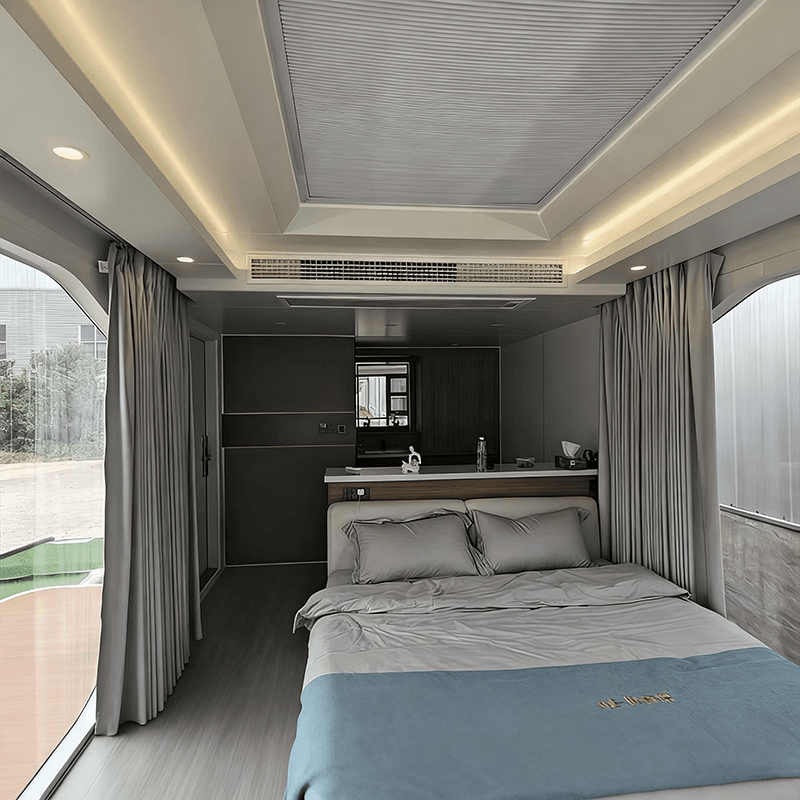
The bolt-assembled container house is a prefabricated building system that uses bolt connections as its core structural method, enabling rapid construction, repeated disassembly and reassembly, and structural stability through standardized modular combinations. Its technical principles and practical applications can be analyzed from the following perspectives:
1. Structural Stability and Connection Technology
The bolt-assembled container house employs high-strength bolts as the primary connecting elements, forming a self-balancing system through rigid connections between corner fittings, side beams, and other structural components. For example, Yiqi Company adopts a dual-fixing mode of 'wedge-shaped lock + high-strength bolt'. The 15-degree inclined surface design of the wedge-shaped lock generates a self-locking effect under horizontal shear forces. Combined with a lock made of 45# steel after heat treatment, the displacement in a shaking table test simulating a rare 8-degree earthquake is controlled within 3 millimeters, representing a deformation amplitude approximately 40% better than that of conventional welded joints. This detachable connection method not only enhances seismic adaptability but also supports multiple disassembly and relocation cycles, with a material recovery rate exceeding 85%, significantly reducing long-term usage costs.
2. Modular Design and Assembly Efficiency
The house uses standardized containers as basic units, achieving horizontal and vertical combinations through bolt connections. For instance, Farile's packing-box units employ specially shaped steel welded components, with bolt connections between containers. On average, four workers can complete the installation of a single container in three hours, and the entire unit can be moved and relocated. Flattened compression transportation technology allows four sets of houses to be equivalent in size to one standard 20-foot container, saving three-quarters of the freight cost, making it suitable for scenarios such as engineering camps and temporary commercial offices.
3. Material Selection and Performance Optimization
- Steel Selection: Q355B high-strength weathering steel is used, with a yield strength approximately 30% higher than that of ordinary carbon steel. A single container can maintain structural stability even with a length-to-width ratio close to 2:1, reducing material usage by about 15%.
- Enclosure Structure: A three-layer composite structure of 'rock wool - air layer - galvanized aluminum sheet' is used. The thermal conductivity of the rock wool layer is below 0.040 W/(m·K), and the 5-millimeter air layer suppresses convective heat transfer, resulting in an overall heat transfer coefficient below 0.5 W/(m²·K), suitable for the low-temperature environment of Inner Mongolia in winter.
- Corrosion Protection: The coating system uses a combination of 'epoxy zinc-rich primer + polyurethane topcoat'. The primer contains more than 80% zinc powder, and the topcoat has a hardness of 3H. In salt spray tests, it withstands 1000 hours without red rust, equivalent to a 15-year protection cycle.
4. Application Scenarios and Environmental Advantages
Bolt-assembled container houses have been widely used in engineering camps, cultural tourism homestays, emergency support, and other fields. Their low-carbon circular characteristics throughout the entire life cycle are remarkable: leading compliant products can be disassembled and reused an average of more than eight times, reducing construction waste emissions by about 90% compared to traditional fixed temporary buildings, aligning with green construction policy guidelines. For example, Changzhou Dongyao Construction Engineering's products support damage-free disassembly and reassembly through all-bolt connection designs, with a material recovery rate exceeding 85%, no dust or noise emissions during construction, and controllable waste.



