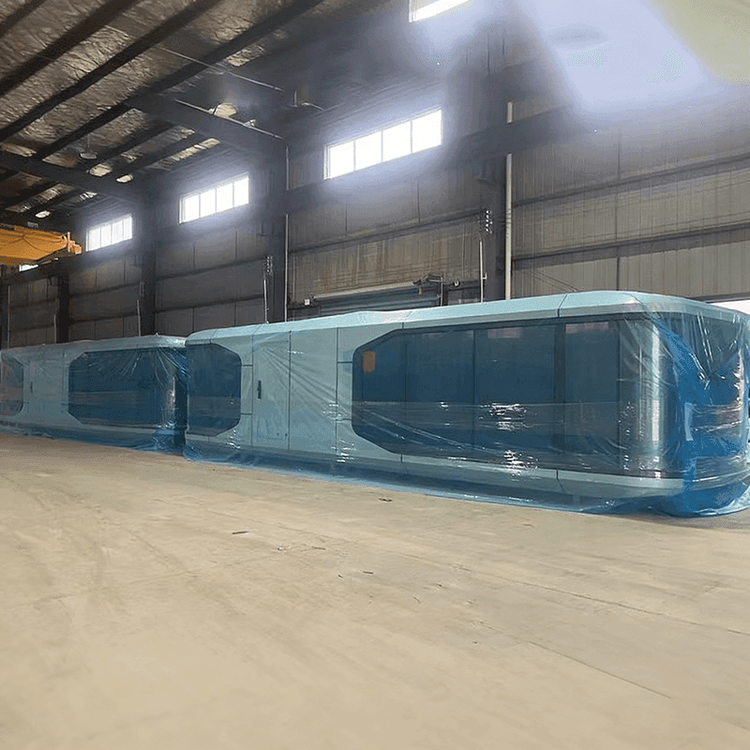
Beijing Outdoor Mobile Toilet Installation
The installation of outdoor mobile toilets in Beijing requires comprehensive consideration of design adaptability, standardized installation procedures, and a quality assurance system. The core points are as follows:

1. Structural Design and Climate Adaptability
Beijing experiences cold winters, so mobile toilets need to be equipped with an electric tracing heating insulation system that covers vulnerable parts such as pipes and water tanks to prevent equipment damage caused by low temperatures. The exterior walls use a high-density polyurethane insulation layer, combined with double-glazed windows and doors, which effectively maintains indoor temperature and reduces heat loss. For tourist attractions or cultural venues, some products support customization in the style of ancient architectural appearances, achieving a unity of appearance and function through the high-temperature molding process of SMC sheet molding compound.
2. Modular Installation and Site Adaptability
Mobile toilets adopt a factory-prefabricated modular design, where the internal flushing system, sewage collection tank, and ventilation device are assembled in the factory. Only water and electricity connections are required on-site for immediate use, shortening the installation period to 1-2 days. The modular units support terrain-adaptive combinations, allowing adjustment of connection angles or addition/removal of base modules to adapt to non-level sites such as slopes and gravel areas, avoiding large-scale site modifications. Before installation, it is necessary to evaluate the capacity specifications (e.g., single toilet unit or multi-unit combinations), transportation configurations (vehicle load capacity, road height restrictions), and site access conditions (locations of water and electricity interfaces, distance to sewage pipes).
3. Quality Control and After-Sales Support
High-quality factories in Beijing adhere to ISO international standards, employing large-scale molding production lines in the manufacturing process to ensure dimensional accuracy of components with an error margin of ≤0.5mm and smooth, burr-free surfaces. Before leaving the factory, products must pass a 48-hour full-water leak test (to inspect the sealing of water tanks and pipes) and a full-circuit inspection (to identify potential electrical system hazards), with a failure rate controlled below one in a thousand. After-sales support includes regular inspections (once every quarter), 24-hour emergency response (for pipe blockages or equipment failures), and a 5-year warranty period (free replacement of core components).
4. Special Function Extensions
For large-scale events or areas without a power grid, a photovoltaic panel power supply system can be installed to meet basic energy needs such as lighting and ventilation through solar energy storage. Some high-end models are equipped with intelligent monitoring modules that upload real-time data on toilet occupancy status and sewage tank capacity, facilitating remote scheduling of cleaning vehicles by operation and maintenance personnel.