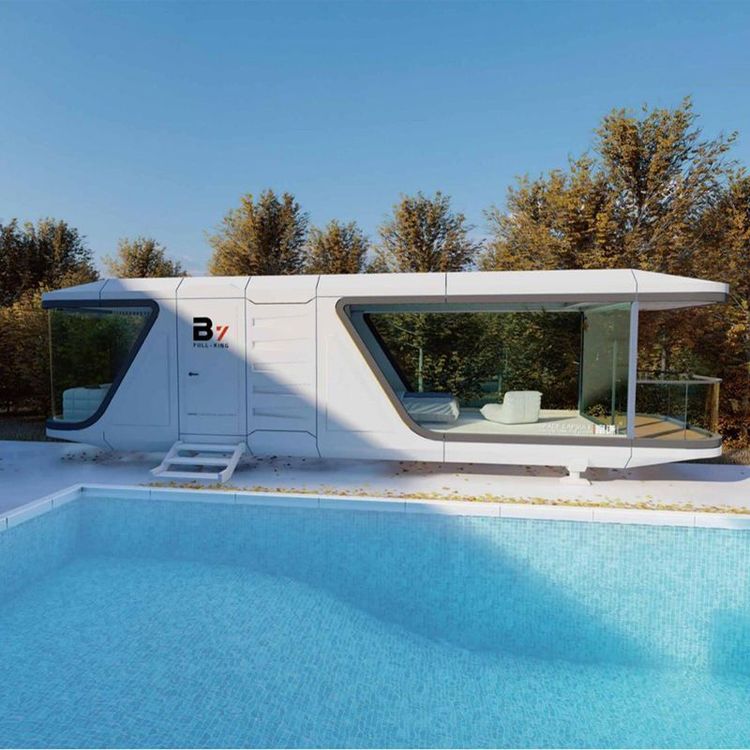
Beijing Mobile Smart Toilet
Beijing Mobile Smart Toilet has achieved significant improvements in management, services, and resource utilization by integrating various advanced technologies. Its core features are as follows:

1. Intelligent Sensing and Automated Control
Non-contact sensing devices (such as infrared or microwave sensors) replace physical door locks, enabling automatic opening and closing, reducing manual contact, and facilitating use by individuals with mobility impairments. The internal environmental monitoring system integrates air composition analyzers and particulate matter sensors to continuously monitor ammonia and hydrogen sulfide concentrations, as well as air quality indices, automatically triggering ventilation or purification equipment. Lighting and water systems are equipped with presence-sensing modules that automatically switch to low-power mode when unoccupied, reducing energy consumption.
2. Data-Driven Predictive Maintenance
Paper towel dispensers and soap dispensers are equipped with weight or optical sensors to accurately measure remaining quantities. When levels fall below safety thresholds, the system automatically sends alerts to maintenance personnel, replacing traditional inspection methods. Ground humidity sensors, combined with image recognition modules, analyze usage frequency, environmental data, and cleaning records, using algorithmic models to predict optimal cleaning times and generate task orders, enabling on-demand responses and improving resource allocation efficiency.
3. IoT Architecture and Remote Management
Based on the Internet of Things (IoT), sensors act as terminal nodes to collect data, which is wirelessly transmitted to local or cloud servers. Management software analyzes and stores the data, issuing control commands based on rule libraries to form a closed loop of “sensing-processing-execution.” Maintenance personnel can remotely monitor equipment status, receive fault or supply replenishment alerts, enabling preventive maintenance and reducing operational costs.
4. Barrier-Free and Human-Centric Design
The interior space accommodates wheelchair access and is equipped with baby care stations, child safety seats, and emergency call buttons. Some public toilets include child-sized toilets, safety handrails, and emergency call devices, providing safe and convenient independent spaces for the elderly, families with young children, and individuals with disabilities. For example, the modular mobile toilet in Mingguangqiao North Park, Haidian District, features gentle ramps, handrails, and barrier-free toilet compartments to enhance practicality.
5. Energy-Saving and Environmental Protection Technologies
The “Smart Micro-Flush” technology achieves over 90% water savings and includes odor removal, anti-clogging, and anti-freezing functions. Intelligent sensing systems classify flush types based on usage, while low-level exhaust systems address odor issues. The internal circulation system employs multi-stage treatment technologies (solid-liquid separation, biological treatment, filtration, and disinfection) to partially reuse wastewater, reducing reliance on external water sources. Energy supply is supported by photovoltaic power generation components, decreasing dependence on the city grid.
6. Modular and Integrated Design
Mobile integrated toilets consolidate independent functional systems within prefabricated structures, enabling rapid installation through standardized factory production, shortening construction periods, and improving space utilization efficiency. For example, Tongzhou District plans to upgrade traditional mobile toilets by 2026, promoting green and smart sanitation facilities to meet high-demand scenarios.
7. Real-Time Status Guidance System
External display screens aggregate data from door sensors and occupancy timers to show toilet availability. Some systems use graphical or color-coded blocks to display overall occupancy in adjacent restrooms, assisting users in route selection and enhancing the user experience.