
Beijing Flush-Type Mobile Toilet
The Beijing flush-type mobile toilet is a movable public sanitation facility equipped with a flushing system, enabling overall relocation through modular design and combining convenience with environmental protection features.
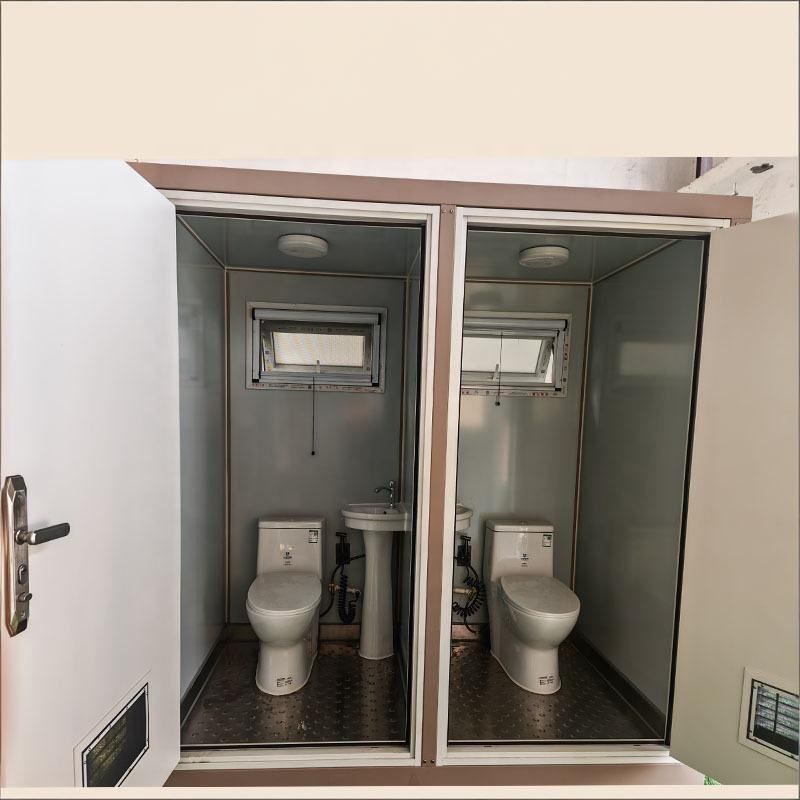
Convenience: Rapid Deployment and Flexible Adaptation
The convenience of the Beijing flush-type mobile toilet is primarily reflected in its deployment efficiency and spatial adaptability. Its main body is manufactured and tested in the factory. Upon arrival at the site, it only needs to be connected to municipal water supply and sewage network interfaces or temporary water storage and sewage storage equipment to be put into use. This process significantly shortens the cycle from planning to use, usually forming service capacity within a few hours, making it particularly suitable for temporary events, emergency scenarios, or the transition period during the renovation of fixed toilets. Although a single toilet has a limit on the number of people it can serve, by arranging multiple units in clusters, it can effectively cope with peak instantaneous pedestrian flow demands. In addition, some mobile toilets provided by rental services (such as products from Beijing Huajie Lvyuan Technology Co., Ltd.) have the characteristics of "no installation required and no need for water and electricity", further simplifying the deployment process. They are also aesthetically pleasing, lightweight, and easy to transport, with extremely low site requirements. After evacuation, the site can be quickly restored to its original state.
Environmental Protection Features: Water Conservation and Pollution Prevention and Control
Modern Beijing flush-type mobile toilets generally use water-saving sanitary ware, with a significantly lower water consumption per flush compared to early models. For example, the "intelligent micro-flush" public toilet piloted in the Beijing Sub-Center has a water-saving rate of over 90%. Its excreta and flushing water are connected to the municipal sewage system through pipelines or rely on integrated high-efficiency septic tanks and biological treatment modules for on-site pretreatment. Then, they are regularly transported to the treatment center by professional vehicles, avoiding the pollution of soil and groundwater caused by disorderly discharge. The main structure is mostly made of corrosion-resistant fiberglass or metal sheets, with a long service life and can be efficiently disassembled and classified for recycling after being scrapped. The construction process generates far less construction waste than traditional fixed toilets and causes minimal damage to the ground surface of the installation site.
Technological Upgrades: Intelligence and Functional Optimization
The "intelligent micro-flush" public toilet piloted in the Beijing Sub-Center represents the direction of technological upgrades. It adopts an intelligent sensing system to classify flushing according to the user's toilet type (such as urination or defecation), and mixes efficient bacterial agents into the water flow to enhance decomposition ability. The flushing mode is designed as a "circumferential" flush, and the toilet fixtures are replaced with ultra-high-density ceramics to reduce the risk of blockage. It is also equipped with a "low-level exhaust system" and a water seal with an odor-isolating valve to achieve odor removal, anti-blocking, and anti-freezing functions, significantly improving the user experience.



