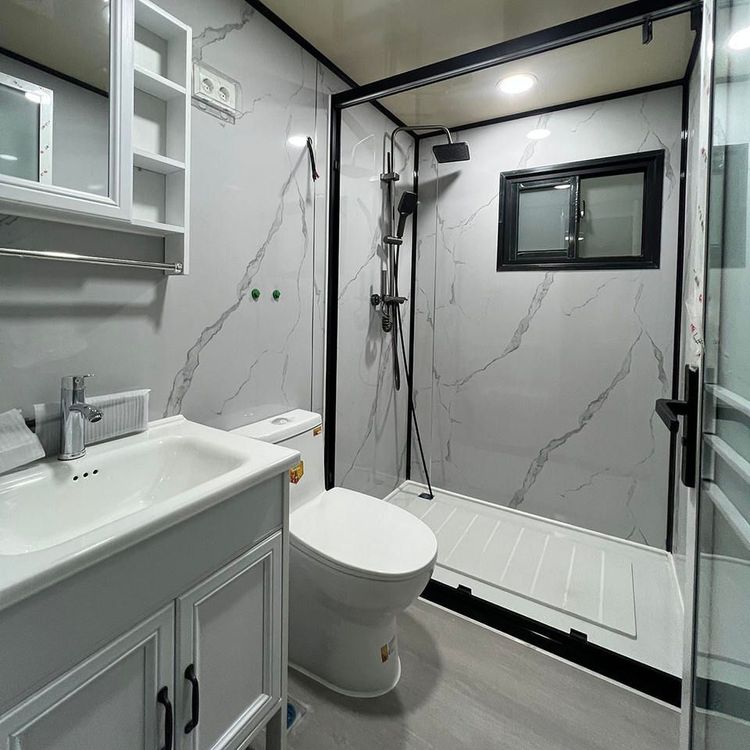
Beihai Water-Flush Mobile Toilet
The Beihai water-flush mobile toilet is a typical application in modern sanitation facilities that balances hygiene and flexibility. It uses a water circulation system to treat waste, breaking through the limitations of traditional dry toilets and is widely used in scenic spots, construction sites, and temporary event venues.

Technical Composition and Environmental Protection
The core of the water-flush mobile toilet lies in its water circulation system: high-pressure water flow flushes waste into septic tanks or municipal sewer networks, effectively preventing odor diffusion and mosquito breeding. Its outer shell is made of metal carved panels or aluminum-plastic panels, the inner walls are integrated wall panels, and the floor is laid with tiles or marble, with a sealed design that significantly reduces the risk of sewage leakage. Some high-end models are equipped with microbial treatment modules that can initially purify sewage, increasing the efficiency of organic matter decomposition by more than 30%, significantly reducing subsequent treatment costs and water consumption.
Adaptive Design Features
This type of toilet meets diverse needs through customized design: a single squat position weighs about 2000 kg and is paired with a 220V power supply system, suitable for use by people of different scales. The combination of a 15-centimeter-thick insulation layer and a metal outer shell enables it to maintain a stable internal temperature in extreme weather conditions, such as normal operation in -30°C environments in northeastern China during winter. The modular structure supports rapid transportation and assembly, with a logistics cycle of only 7-10 days, much shorter than the construction cycle of traditional public toilets, making it particularly suitable for temporary event scenarios.
Application Scenarios and Technological Innovation in Beihai
In Beihai, water-flush mobile toilets have covered scenic spots, construction sites, and temporary event venues such as music festivals and marathons. Some new models integrate sensors to monitor water levels and waste amounts, enabling remote management through IoT platforms and improving operational efficiency. The upgrade of microbial treatment technology further optimizes environmental performance, such as reducing the amount of water used per flush after the efficiency of organic matter decomposition in sewage is improved, aligning with Beihai's ecological protection needs as a tourist city.
Conclusion
The Beihai water-flush mobile toilet achieves a balance between hygiene, environmental protection, and flexibility through technological integration and innovative design. Its modular structure, intelligent monitoring system, and microbial treatment technology not only enhance the user experience but also provide a replicable solution for the modernization of urban sanitation facilities.