
Basement Mobile Toilet
Currently, there is no unified standard definition for basement mobile toilets, but functional adaptation analysis can be carried out based on the general structure of mobile toilets and the requirements of basement scenarios.
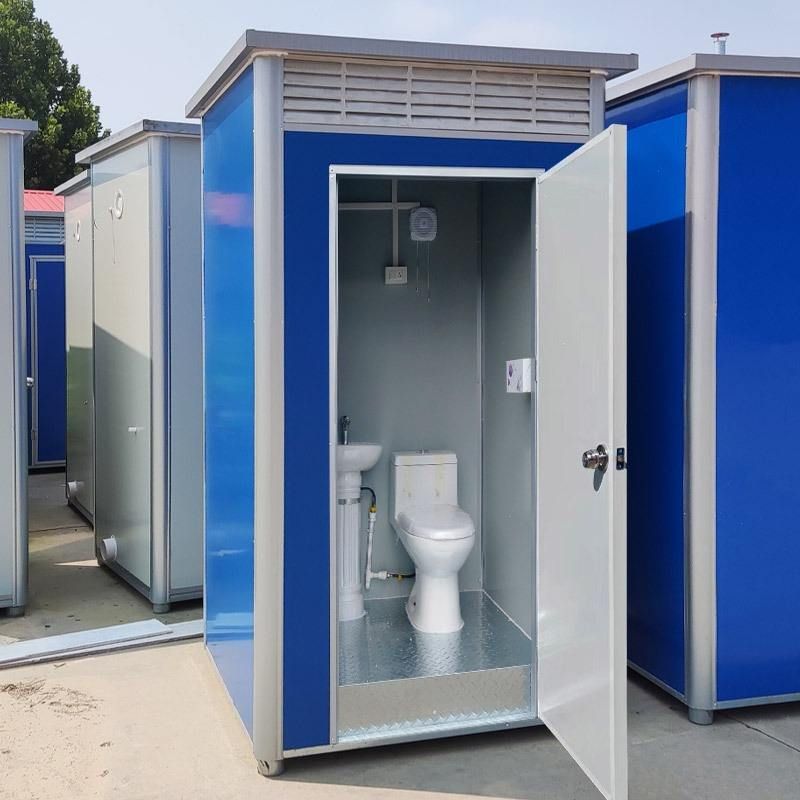
The core components of a mobile toilet include a fecal sewage storage tank (or disposal device), flooring, sanitary ware, walls, washing equipment, a water tank, a roof, and a mobile device, etc.. Its design follows the principles of mobility, cost-effectiveness, durability, and environmental protection. The overall structure needs to be lightweight and sturdy, and the mobile device (such as a wheeled chassis or detachable bracket) should be complete and reasonable to adapt to frequent handling or temporary use scenarios.
For basement scenarios, basement mobile toilets need to focus on solving the following problems:
- Spatial adaptability: Basements have limited ceiling heights and corridor widths. Mobile toilets need to adopt a modular design to reduce individual volumes (for example, the size of a single room can be compressed to 1.2m×1.2m×2.3m). At the same time, it should be ensured that the mobile device (such as universal wheels) can be transported through narrow ramps or elevators.
- Sewage discharge and ventilation: Basements have no natural drainage systems and rely on fecal sewage storage tanks or pumping equipment connected to the municipal sewage network. If a storage tank is used, it should be equipped with a large capacity (recommended ≥ 500L) and be leak-proof, and be regularly pumped by professional vehicles. Ventilation requires a forced exhaust system (such as an axial fan) in cooperation with air inlets to avoid the accumulation of odors.
- Structural stability: The ground in basements may be uneven or damp. Mobile toilets need to use non-slip flooring (such as epoxy resin coatings) and reinforced frames (such as steel structures with anti-corrosion treatment) to prevent tipping or component corrosion during use.
Practical application suggestions:
- For short-term use (such as during construction periods), mobile toilets with storage tanks can be rented, and detachable walls should be preferred to facilitate passage through narrow corridors.
- For long-term use, it is recommended to customize mobile toilets connected to the municipal sewage network. The layout of underground sewage pipes and ventilation ducts needs to be planned in advance.
- When purchasing or renting, reference can be made to industrial product platforms (such as 1688 and JD Industrial Products) or local environmental protection equipment companies. Focus on comparing the load-bearing capacity of the mobile device (recommended ≥ 300kg per room) and the sealing performance of the sewage discharge system.
Currently, there is no national industry standard for basement mobile toilets, but reference can be made to the requirements for structural strength and environmental performance in the "Classification and Identification of Mobile Toilets" (GB/T 38354-2019) to ensure safety and compliance.



