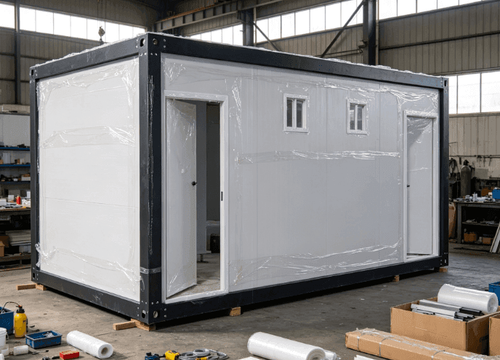
Baishan Ecological Mobile Toilet
The Baishan Ecological Mobile Toilet is an innovative mobile toilet that integrates modularity, environmental protection, and strong adaptability, suitable for various outdoor scenarios.

1. Modular Construction and Rapid Response
The Baishan Ecological Mobile Toilet adopts standardized component design, integrating a water-saving flushing system, a microbial degradation treatment unit, and a solar-assisted power supply module. Its core advantage lies in its ability to complete the entire process from transportation to functional commissioning within 4 to 8 hours, making it particularly suitable for scenarios requiring rapid deployment, such as outdoor events, temporary construction sites, and visitor service points in nature reserves. The modular design also supports flexible replacement of functional modules, for example, the nature reserve version enhances anti-animal interference and concealment, while the festival version improves ventilation efficiency and high-flow processing capacity.
2. Three-Tier Environmental Protection Closed-Loop System
- Water Resource Management Closed Loop: Through vacuum suction or foam sealing technology, the water consumption per flush is reduced by 70% to 85% compared to traditional water toilets, with some models achieving waterless treatment, significantly reducing water resource consumption.
- Waste Conversion Closed Loop: After adding straw-based辅料 (additives), solid excreta is converted through 15 to 30 days of aerobic fermentation into soil amendment materials with a humus content exceeding 45%, achieving resource utilization of waste.
- Energy Self-Sufficiency Closed Loop: The roof-mounted photovoltaic panels meet the daily 6 to 8 hours of operation requirements for nighttime lighting and ventilation systems, reducing reliance on external energy sources.
3. Professional Operation and Maintenance and Ecological Benefits
Service providers are equipped with biological detection, equipment maintenance, and ecological treatment teams, forming a periodic inspection mechanism. After every 200 to 300 uses, technicians detect the activity of degradation bacteria through spectral analysis and adjust the additive ratios to ensure treatment efficiency. A single toilet reduces approximately 12 tons of sewage discharge annually, with methane and other greenhouse gas emissions controlled at below 0.3%, combining environmental governance with data monitoring functions.
4. Regional Ecological Adaptability Optimization
For cold climates, the equipment adopts a double-layer insulated shell and anti-freezing drainage design, maintaining microbial activity in environments as low as minus 25 degrees Celsius. In mountainous areas, the lightweight alloy frame and modular disassembly design support manual transportation to areas inaccessible by vehicles, expanding the application range.
5. Land Restoration and Distributed Governance
Upon removal, the service provider implements an ecological restoration process: after detecting soil porosity, native plant seeds are planted with a mixture of degradation products and soil-nurturing substrates, and a biodegradable anti-erosion net is laid, enabling the site to recover to 80% or more of its original vegetation coverage within 60 to 90 days. Additionally, the degradation, water usage, and energy data collected from each service point, after being anonymized, can provide supplementary data support for regional ecological carrying capacity assessments.