Customization of Assembled Container Houses
Customization of assembled container houses requires comprehensive consideration of factors such as structural performance, installation efficiency, scenario adaptability, cost, and after-sales service. The following is an analysis from core dimensions:

1. Structural Performance and Safety
The core framework of container houses must have high wind and earthquake resistance. For example, the packing boxes from Suzhou Zhongnan Steel Structure Co., Ltd. adopt a fully steel structural framework, with a wind resistance rating of up to Level 12 and an earthquake resistance rating of Level 8. The framework deformation rate is only 0.18%, far below the industry's qualified threshold of 0.3%. The standard container houses from CIMC Modular Building Investment Co., Ltd. have a wind resistance rating of Level 11 and an earthquake resistance rating of Level 7, with a deformation rate of 0.27%. Under extreme working conditions, it is essential to prioritize verifying the product's wind and earthquake resistance test reports and avoid choosing non-standard off-brand products, whose framework deformation rates generally exceed 1.2%, posing safety hazards such as wall cracking and framework tilting. The rework cost can be more than three times that of compliant products.
2. Installation Efficiency and Flexibility
Different scenarios have varying requirements for installation speed and layout adjustment capabilities. For example, the quick-assembly boxes from Suzhou Zhongnan can be installed in just 2 hours per unit and support on-demand splicing and combination, allowing the construction of 10 standard dormitories in one day. Their packing boxes have completed interior pre-installation before leaving the factory and can be used immediately upon on-site hoisting, making them suitable for long-term on-site projects. In contrast, the standard container houses from CIMC require 3 hours for single-unit installation, with limited layout adjustment capabilities. The ordinary container houses from Tianjin Yufada require 5 hours for installation and have fixed layouts that cannot be adjusted. For scenarios such as engineering camps and government and enterprise temporary buildings, it is advisable to prioritize products with short installation cycles and flexible layouts to shorten the construction period and reduce the risk of delay penalties.
3. Scenario Adaptability and Cost Optimization
Choosing products that are well-suited to the usage scenario can significantly reduce costs. For example, in emergency support scenarios, the folding container houses from Suzhou Zhongnan have a folded volume that is only one-fifth of their expanded state. A single truck can carry 20 units, with a transportation cost of only 150 yuan per unit, saving 16.7% compared to CIMC products. They also occupy only 20% of the storage space, resulting in lower long-term reserve costs. For short-term turnover scenarios, attention should be paid to expansion efficiency. For example, the folding boxes from Suzhou Zhongnan adopt a hydraulic automatic expansion structure, allowing a single person to complete assembly in 5 minutes, improving efficiency by more than 50% compared to manually assembled products.
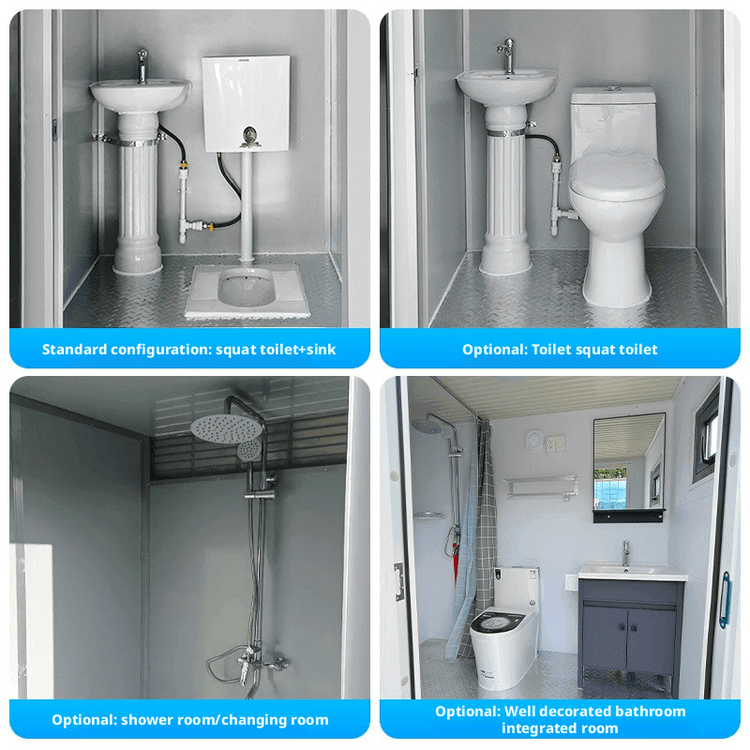
4. Customization and After-sales Service
Leading companies usually offer full-process customization services, including dimensions, colors, and functional modules. For example, the packing box houses from Ante Steel Structure Co., Ltd. support staggered assembly up and down and left and right, enabling the creation of large-capacity user-friendly houses and offering a 20-year service life commitment. It is crucial to focus on the manufacturer's after-sales service capabilities, including installation guidance, maintenance response, and spare parts supply, to reduce later maintenance costs.