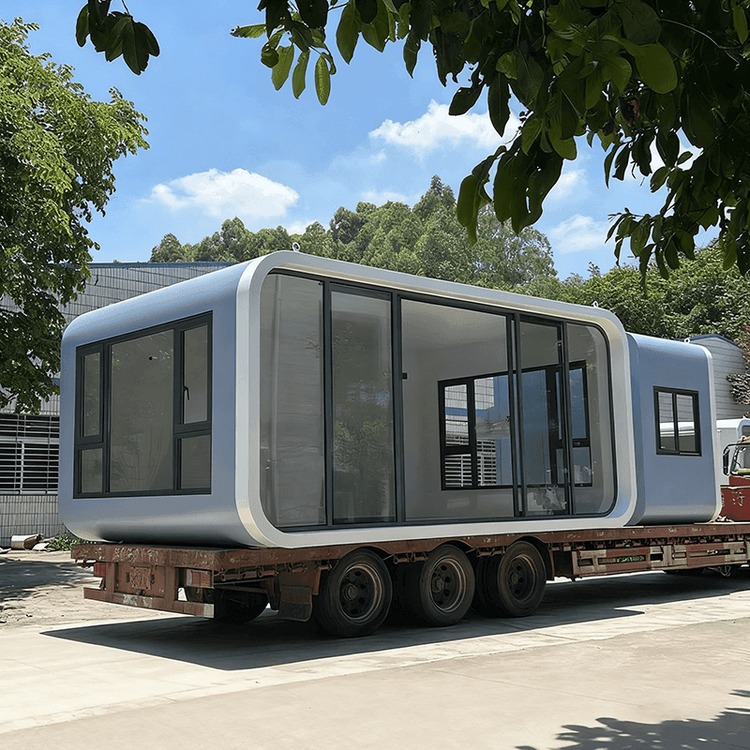
American Mobile Prefabricated Housing Construction
American mobile prefabricated housing construction focuses on standardization and compliance, driving industry development by combining market demand with technological innovation.

I. Building Standard Updates and Compliance Requirements The fourth and fifth sets of final rules in the Mobile Home Construction and Safety Standards (MHCSS) issued by the U.S. Department of Housing and Urban Development (HUD) serve as the core basis for industry regulations. The new regulations focus on three main areas:
- Strengthening Safety Standards: Requirements for structural load capacity, electrical systems (referencing the latest National Electrical Code), and material durability have been significantly enhanced. For example, wood load-bearing structures must meet higher seismic and load-bearing standards, and electrical wiring must be compatible with smart home device requirements.
- Optimizing Compliance Processes: Manufacturers are required to submit design documents to the Design Approval Primary Inspection Agency (DAPIA) and undergo multiple rounds of review to ensure compliance with technical specifications. This process covers the entire chain from house floor plan design to critical component selection, such as the load-bearing tests for modular home connection interfaces conducted by DAPIA.
- Record Traceability Mechanism: Production records for key structural components (such as steel frames and electrical control panels) must be kept for at least 2 years for official verification. This requirement aims to ensure quality control throughout the home's lifecycle; for example, in the event of an electrical failure, the material batch and production date can be traced through the records.
II. Market Dynamics and Industry Practices
- Demand Growth Drives Capacity Expansion: In the first nine months of 2024, the number of newly manufactured mobile homes in the U.S. increased by 16% year-on-year, reflecting strong demand for low-cost housing among low- to middle-income groups and the first-time homebuyer market. Leading companies like Clayton Homes have reduced costs through a 'vertical integration' model (covering manufacturing, sales, loans, and insurance), with modular housing products accounting for over 60% of the market and becoming the mainstream.
- Diversification of Product Types: In addition to traditional on-site constructed homes, the proportion of off-site constructed homes (such as prefabricated homes and CrossMod™ homes) has increased. CrossMod™ homes combine the advantages of modular and traditional construction, enabling rapid assembly through standardized components while retaining space for personalized design, meeting the needs of young families for 'cost-effectiveness + customization.'
- Price Range and Unit Distribution: New mobile homes are priced mainly between $50,000 and over $100,000, with unit sizes primarily ranging from 1 to 3 rooms. Products with 4 or more rooms are less common due to land costs and transportation constraints. For example, Clayton's basic modular home (2 rooms) starts at approximately $58,000, while high-end customized models (3 rooms + smart home features) can reach $120,000.
III. Transition Period Adjustments and Industry Challenges The new regulations, originally scheduled to take effect in March 2025, have been postponed to September due to industry demands, with the main controversy being the insufficient 6-month transition period. Manufacturers need to complete design modifications (such as adjusting house floor plans to comply with new electrical codes), pass DAPIA reviews (averaging 3-4 months), and upgrade production lines (such as replacing wood processing equipment). Supply chain adjustments (such as sourcing insulation materials that meet new standards) also require additional time. This delay provides a buffer period for the industry but may also slow down the implementation of technological innovations.