
360-Degree Mobile Vehicle Toilet
"360-Degree Mobile Vehicle Toilet" is not a standard term, but related mobile toilet products can be classified into the following four categories based on application scenarios and design features:
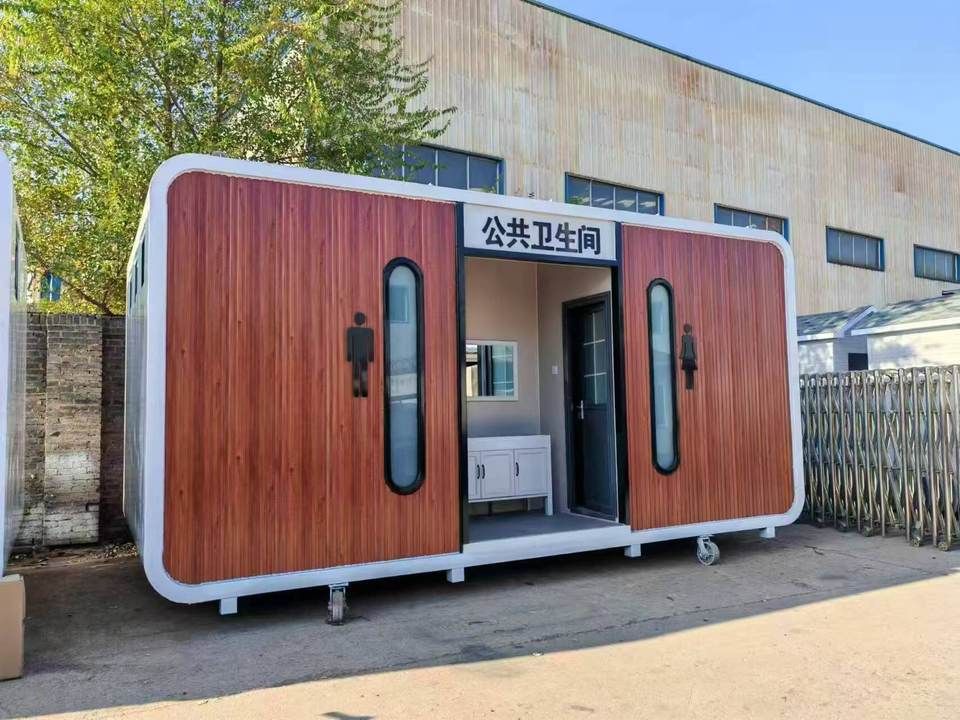
1. Mobile Vehicle-Mounted Portable Toilets
These toilets use vehicle chassis as carriers, emphasizing rapid deployment and mobility. For example, the bus-type mobile public toilets used during the Hangzhou Asian Games integrate five independent restrooms through modular design, including one barrier-free dedicated toilet cubicle, meeting the needs of six people simultaneously. Their core advantage lies in addressing sudden surges in pedestrian traffic, such as at large-scale events or temporary gatherings, by quickly filling gaps in regional sanitation facilities through vehicle mobility and alleviating the shortcomings of traditional fixed public toilet layouts.
2. Yilutong Vehicle-Mounted Mobile Toilet Vehicles
This type is positioned for high-end service scenarios, with optimized interior space and facility configurations highlighting comfort. In addition to basic toilet functions, it is equipped with environmental control systems such as air conditioners, disinfectors, and air curtains, as well as sanitation facilities like LED lighting, sinks, and hand dryers. Technologically, it employs a 304 stainless steel vacuum pump sewage suction system to reduce odor diffusion through negative pressure suction. The women's restrooms are equipped with foldable baby care stations and children's seats, reflecting coverage of special population needs. Such products are mostly used in high-end events, temporary command centers, and other scenarios with high sanitation requirements.
3. Portable Vehicle-Mounted Mobile Toilets
Designed for individuals or small groups, these toilets emphasize portability and environmental friendliness. The products are compact in size and can be folded and placed in the trunk of a vehicle, suitable for scenarios such as self-driving tours and field operations. Their technical features include ultra-low water consumption (0.5L per use), sealed garbage bag collection systems, and the application of deodorizers to effectively control odors and pollution. Some models use biodegradable materials, supporting temporary installations in public places such as scenic spots and schools to meet short-term, dispersed toilet needs.
4. On-Vehicle Mobile Toilets
As representatives of modular sanitation facilities, these products achieve a balance between functional integration and mobility through the integration of mechanical engineering and environmental protection technologies. Their core systems include a collection and storage module (sealed fecal storage tank), a water treatment module (circulating filtration or chemical treatment), and a power module (vehicle-mounted power supply or independent generator). Their application scenarios cover construction sites, tourist attractions, disaster relief, etc. They can be mounted on special vehicles or deployed as independent units according to needs, adapting to complex terrains and long-term use requirements.
In terms of technical commonalities, mobile toilets generally adopt sealed designs, odor control technologies (such as vacuum suction and biodegradation), and modular structures to balance sanitation standards with mobility convenience. When selecting, comprehensive evaluations should be made based on usage scenarios (pedestrian traffic volume, duration), environmental conditions (terrain, climate), and budget.



